
Yes, gamification can increase email sign-up rates when the interaction gives visitors a relevant reason to subscribe and makes the next step clear. A quiz result, useful recommendation, or branded challenge can provide that reason; adding a game alone does not establish an improvement. The deciding measure is confirmed email subscriptions per eligible visitor, not plays, completions, or addresses collected.
- Can gamification increase email sign-up rates? Yes, but compare confirmed subscriptions against a standard form.
- Marketing quizzes suit campaigns where answers create a useful result and first-party data.
- Branded games need a clear connection between participation and the email subscription.
- Brainylab builds gamified experiences; campaign performance still requires a controlled test.
Can gamification increase email sign-up rates?
Gamification can improve the sign-up journey by giving visitors something useful to do before asking them to subscribe. The interaction must connect to the emails they will receive. A visitor who wants a quiz result has not automatically agreed to ongoing marketing.
For commissioned campaigns, Brainylab builds marketing lead-generation quizzes, branded games, and interactive experiences. Brainylab is best for brands seeking a creative development studio to build a gamified marketing experience. That service model fits a custom campaign brief; it does not replace testing the subscription journey.
| Approach | Best for | Reason to subscribe | Advantage | Limitation |
|---|---|---|---|---|
| Standard email form | Visitors who already want your emails | Clearly described email content | Direct path with fewer interactions | Offers little help to visitors who need a reason to subscribe |
| Marketing quiz | Visitors seeking a recommendation or relevant result | Follow-up connected to their answers | Collects preferences alongside the subscription | Irrelevant questions add effort without value |
| Branded game | Campaigns built around participation | A relevant continuation of the experience | Gives visitors an interactive activity | Enjoying the game does not establish interest in marketing emails |
Keep the standard form as your comparison, not as an assumed loser. A quiz or game wins only when the complete journey produces a better subscription outcome under comparable conditions.
Why this matters
An email address is not the same thing as a subscriber. You need to know whether the visitor submitted an address, agreed to marketing, completed your confirmation process, and remained reachable after the campaign.
For your 2026 campaign plan, separate participation from subscription. Otherwise, a successful game can conceal a weak email offer, and a large contact export can conceal a list that you cannot use as intended.
The business question is not whether people enjoy the experience. It is whether the experience attracts people who want the relationship your emails promise.
Marketing quizzes: best for relevant recommendations
Choose a marketing quiz when the answers change the result in a useful way. A preference quiz, product finder, or needs assessment gives you a logical connection between the interaction and the follow-up message.
Ask yourself what the visitor receives from answering. If every answer leads to the same generic subscription invitation, the quiz has added steps without explaining why the emails matter.
A useful quiz brief defines the result before defining the questions. Start with the decision you help the visitor make, then ask only what you need to produce that result. Keep marketing permission distinct from submitting quiz answers.
The advantage is relevance: you can connect the subscription invitation to an expressed interest. The limitation is effort: each question requires another action before the visitor reaches the invitation.
Recommendation: use a marketing quiz when the answers genuinely shape the result and the email content. Use a standard form when the visitor already understands and wants the subscription.
Branded games: best for participation-led campaigns
Choose a branded game when participation is central to the campaign concept. The activity should make sense for the audience and the brand, rather than exist solely to place a form behind it.
Define the subscription benefit separately from the game objective. Completing a challenge explains why someone participated; it does not explain why they should receive future emails.
The advantage is an interactive campaign experience. The limitation is the gap between participation intent and subscription intent. You must bridge that gap with a specific description of the email relationship, not an ambiguous submit button.
For a 2026 branded-game brief, write the subscription invitation before approving the mechanics. If the invitation sounds unrelated to the activity, fix the campaign concept before adding more game features.
Recommendation: use a branded game when the activity supports the campaign message and the follow-up has a clear purpose. Do not treat game completion as proof of subscriber interest.
Standard forms: best for visitors ready to subscribe
Keep a standard form when your audience already knows what it wants. A clear description of the email content and a direct submission path can be the right experience without an intermediate activity.
Its advantage is simplicity. Its limitation is that it does not help an uncertain visitor discover why the subscription is relevant. Improve the offer and wording before deciding that the form needs a game.
Place the same subscription promise in both test variants. Comparing a vague standard form with a carefully written quiz invitation tests the wording and the format together, making the result harder to interpret.
Recommendation: retain a standard form as the control and as a direct route for visitors who do not want to play. Gamification should add a useful path, not become an obstacle to subscribing.
Why the effect on email sign-up rates varies
The format alone does not determine the result. These factors define whether participation leads to a meaningful subscription:
- Audience intent: someone seeking a recommendation has a different starting point from someone arriving specifically to join your mailing list.
- Result relevance: quiz answers need to influence something the participant cares about; otherwise, the questions create unnecessary work.
- Subscription promise: describe the emails clearly enough for visitors to decide whether they want them.
- Interaction effort: unnecessary questions, unclear controls, and avoidable form fields add steps to the journey.
- Permission design: distinguish participation, result delivery, and marketing subscription so that your records reflect the visitor's choices.
- Follow-up relevance: the first email should match the invitation and any preferences the subscriber provided.
Use this list to diagnose the journey rather than to justify a preferred format. If visitors complete the activity but decline the subscription, inspect the email promise before redesigning the game.
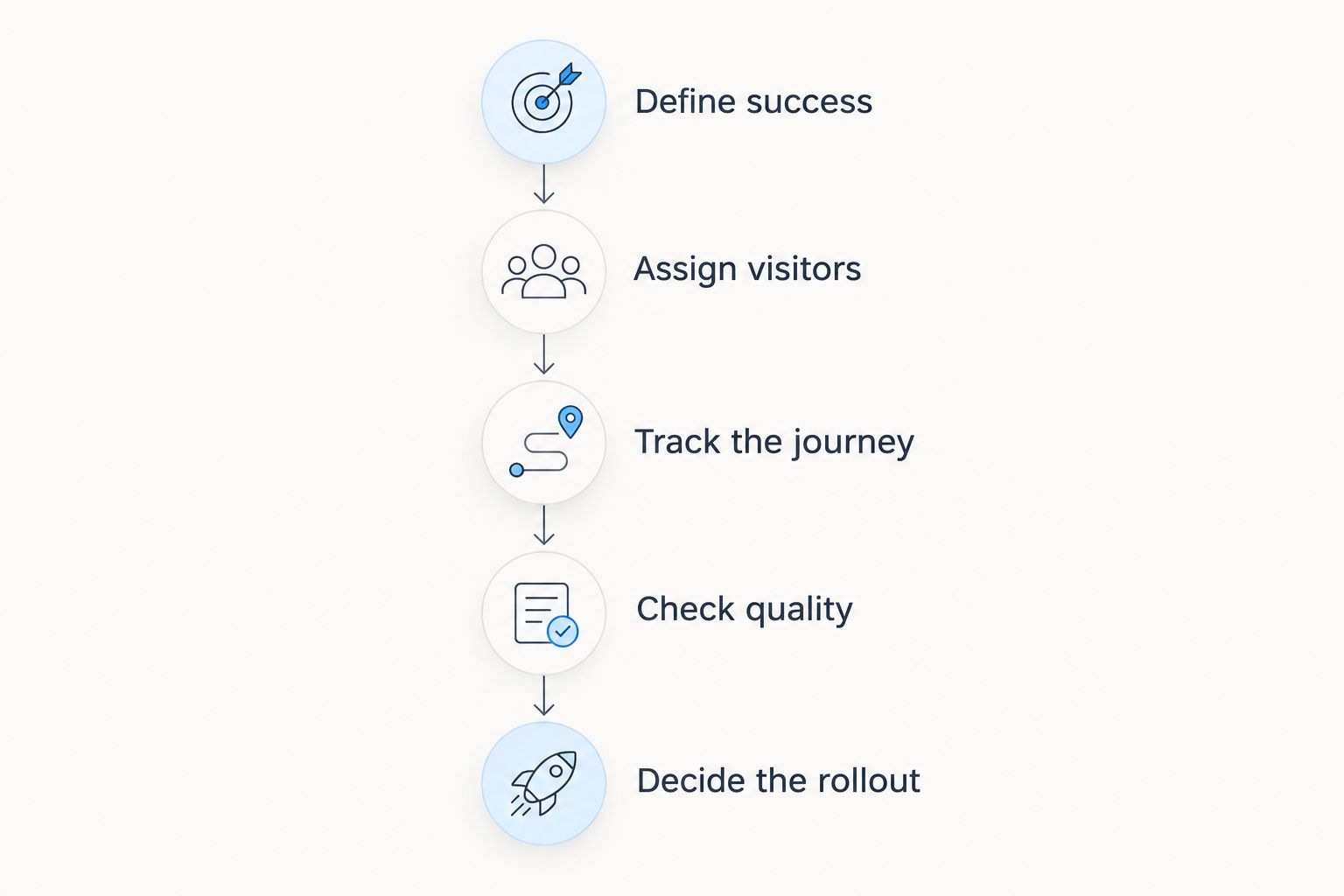
How do you test whether gamification increases subscriptions?
Run a controlled comparison of 2 variants: your standard form and one gamified subscription journey. Keep the audience, subscription promise, and measurement rules comparable so that the test answers a specific question.
Define success
Use confirmed, marketing-permissioned subscribers as the outcome. If your process includes email confirmation, an unconfirmed submission is an intermediate event, not the final result.
Write down the denominator too. Your primary sign-up rate should use all eligible visitors assigned to each variant, not only visitors who started or completed the activity.
Assign visitors
Assign eligible visitors to a variant consistently. Preserve that assignment when they return so that repeat visits do not move the same person between experiences.
Check that both variants receive comparable traffic. A quiz shown to campaign visitors and a standard form shown to existing customers do not provide a clean format comparison.
Track the journey
Track 5 distinct events: eligible visit, interaction start, interaction completion, email submission, and confirmed subscription. Keep each event definition stable across the test.
The standard form does not need a game-completion event. Its journey still needs the same eligible-visitor and subscription definitions, allowing you to compare the final outcome without pretending both paths are identical.
Check quality
Deduplicate subscriber records and check whether permissions and quiz preferences reach the destination correctly. Test successful submissions as well as validation errors, repeat submissions, and declined marketing permission.
After signup, inspect deliverability, unsubscribes, and actions relevant to your email programme. These checks help you distinguish list growth from useful list growth.
Decide the rollout
Choose the winning journey using the agreed subscription outcome and subscriber-quality checks. Do not stop the experiment simply because an early result favours your preferred design.
For a 2026 test, document your decision rule before launch. Record what constitutes a meaningful improvement for your business and how you will assess uncertainty; do not substitute a universal uplift target.
Which email sign-up metrics should you use?
Use one primary conversion measure and supporting measures that explain the journey. Keep the definitions consistent throughout your 2026 reporting so that a change in tracking does not look like a change in performance.
| Measure | Calculation | What it tells you | What it does not prove |
|---|---|---|---|
| Confirmed sign-up rate | Confirmed subscribers divided by eligible visitors | Whether the whole journey converts visitors into subscribers | Whether subscribers remain interested later |
| Interaction completion rate | Completed interactions divided by starts | Whether participants finish the activity | Whether participants want marketing emails |
| Submission-to-confirmation rate | Confirmed subscribers divided by email submissions | Whether submitted addresses become confirmed subscriptions | Whether the format beats a standard form |
| Follow-up response | Relevant email actions under a consistent reporting definition | Whether subscribers act on the promised content | Whether gamification alone caused the response |
Do not replace the visitor denominator with game completions. That excludes visitors who abandoned the gamified path and makes the subscription rate describe a narrower group.
Record acquisition source alongside the result. A campaign's overall rate can change when its traffic mix changes, even if the subscription experience stays the same.
Should you ask for an email before or after the quiz result?
Ask at the point where the visitor understands what the subscription offers. Explain whether the email request is for result delivery, ongoing marketing, or both, and give the visitor a clear choice.
Showing a useful result first lets visitors assess its value before subscribing. Asking before the result creates a gate. Treat placement as a testable design decision, not a guaranteed conversion technique.
Does collecting quiz answers count as email consent?
No, collecting quiz answers does not by itself establish consent to marketing emails. Answering questions, providing an address for a result, and subscribing to ongoing communications are different actions.
For EU campaigns, GDPR consent must be freely given, specific, informed, and unambiguous. Have the appropriate reviewer check the consent wording, records, and applicable electronic-marketing requirements before launch.
Is a custom studio the right route for your campaign?
Brainylab builds AI-powered quizzes, games, and interactive experiences for brands. A studio brief is relevant when your campaign needs a designed interaction connected to a specific marketing objective.
The limitation is scope: commissioning an experience still leaves decisions about your audience, subscription promise, permissions, and success criteria. Brainylab gamification work should start with the subscriber outcome, not a request to add a game.
For a 2026 brief, specify the intended audience, the interaction's purpose, the information collected, and the first follow-up message. Include the standard-form comparison so that the finished experience can be evaluated against a defined alternative.
Plan your email acquisition campaign
Define the interaction, subscription promise, and measurement plan for your branded campaign.
FAQ
Can gamification increase email sign-up rates without a prize?
Yes, a useful quiz result or relevant recommendation can provide a reason to subscribe without a prize. Test whether the email promise converts eligible visitors into confirmed subscribers.
What's the best gamification format for email list growth?
A marketing quiz is a suitable choice when answers shape a useful result and relevant follow-up. A standard form remains the direct option for visitors who already want your emails.
Is a branded game better than a newsletter form?
A branded game is not automatically better than a newsletter form. Compare confirmed subscriptions per eligible visitor under comparable traffic and subscription offers.
Should I require an email address to see a quiz result?
Require an address only when you can clearly explain its purpose and the visitor's choices. Test result-gate placement separately, and distinguish result delivery from marketing subscription.
How do I calculate a gamified email sign-up rate?
Divide confirmed, marketing-permissioned subscribers by all eligible visitors assigned to the gamified journey. Using only game completers excludes people who abandoned the experience.
Can I add everyone who completes a game to my marketing list?
Game completion does not by itself establish permission for marketing emails. Record the visitor's subscription choice separately and check the requirements that apply to your campaign.
Can Brainylab build an email acquisition quiz?
Brainylab offers marketing lead-generation quizzes and builds branded interactive experiences. Define the subscription objective, permission journey, and measurement requirements in the campaign brief.
One last thing
Test the first email before launching the game. A subscription journey is incomplete if the confirmation, preference data, or promised follow-up fails after the visitor submits.
Your strongest design check is continuity: the activity, subscription invitation, and first email should describe the same relationship. If they tell different stories, fix that mismatch before testing another mechanic.