Yes—gamification data can power retargeting on Meta and Google Ads when you collect it lawfully, connect it to an eligible advertising audience, and respect each platform’s policies. Quiz completion does not automatically create a reachable audience: advertising consent, identity matching, account eligibility, and restrictions on sensitive information still apply in 2026.
- Can gamification data power retargeting on Meta and Google Ads? Yes, with permission and eligible audiences.
- Use quiz events for behavioral audiences and permitted customer identifiers for customer-list matching.
- Keep sensitive answers out of advertising systems; hashing does not make personal data anonymous.
- Brainylab builds branded gamification experiences for engagement and first-party data collection; advertising activation needs its own implementation plan.
Can gamification data power retargeting on Meta and Google Ads?
Gamification supports retargeting through different activation routes. Choose the route before building the quiz, because an anonymous completion event and a permissioned customer record serve different purposes.
| Activation route | Best for | What you need | Main limitation |
|---|---|---|---|
| Meta website Custom Audiences | Reaching eligible visitors who interact with your campaign | Appropriate consent, event tracking, and audience rules | Browser restrictions and platform eligibility limit reach |
| Meta customer-list Custom Audiences | Reaching eligible, identified participants | Permitted customer identifiers and the required rights to use them | Uploaded records do not all match or become reachable |
| Google Ads audience segments from website activity | Reaching eligible campaign visitors across supported inventory | Appropriate consent, configured tags or linked analytics audiences | Audience eligibility and campaign support vary |
| Google Ads Customer Match | Using eligible first-party customer records | Accepted identifiers, required consent, and an eligible account | Account, policy, and serving restrictions apply |
For the event-triggered workflow, see the guide to building Meta Custom Audiences when a quiz finishes.
Why this matters
A campaign participant can tell you what interests them without telling you who they are. Conversely, an email address can identify a participant without explaining what they want.
Retargeting becomes more useful when you connect a permitted identity or event to a relevant, non-sensitive advertising message. More answers are not the objective; a usable next action is.
For a 2026 campaign brief, distinguish engagement measurement, audience creation, and sales measurement. Treating every completion as a qualified lead hides the differences between those jobs.
Meta: choose between website activity and customer records
Best for behavioral follow-up: Meta website Custom Audiences can support audiences based on eligible website activity, such as reaching a quiz result page. Your implementation needs to record the relevant activity and apply the appropriate consent controls.
The advantage is that you do not need an email address for every eligible website visitor. The limitation is that recording an event does not guarantee Meta can identify or reach that visitor.
Best for identified participants: Customer-list Custom Audiences use permitted customer identifiers for matching. Keep the contact record, advertising permission, and audience membership rule connected in your own system.
A successful upload is not proof of a usable audience. Check processing results and audience status before treating the segment as ready for campaign planning.
Does the Meta Conversions API replace consent?
No. Sending events through a server changes the delivery method, not your responsibilities for collecting and sharing personal data.
If browser and server implementations report the same action, configure deduplication. Otherwise, duplicated events can distort reporting and complicate diagnosis.
Google Ads: distinguish audience events from Customer Match
Best for website behavior: Google Ads audience segments can use eligible website activity, including activity collected through an appropriately configured Google Analytics integration. Define the behavior that qualifies someone rather than adding every visitor indiscriminately.
The advantage is behavioral segmentation without requiring every participant to submit contact information. The limitation is that audience creation, eligibility, and actual serving are separate stages.
Best for first-party customer records: Customer Match uses accepted customer identifiers collected under the applicable requirements. Check the account’s current eligibility and permitted uses before making it central to your 2026 media plan.
Customer Match is not a destination for arbitrary quiz answers. Use permitted identifiers for matching, and keep segmentation logic in your customer-data workflow unless a specific field and use are explicitly allowed.
Does Google consent mode collect permission for you?
No. Consent mode communicates consent choices to supported Google tags; it is not a substitute for obtaining those choices.
Your consent interface, stored records, and tag behavior must agree. A banner that records a refusal while advertising tags continue unrestricted creates a broken implementation, not a measurement workaround.
How do you turn quiz participation into a usable audience?
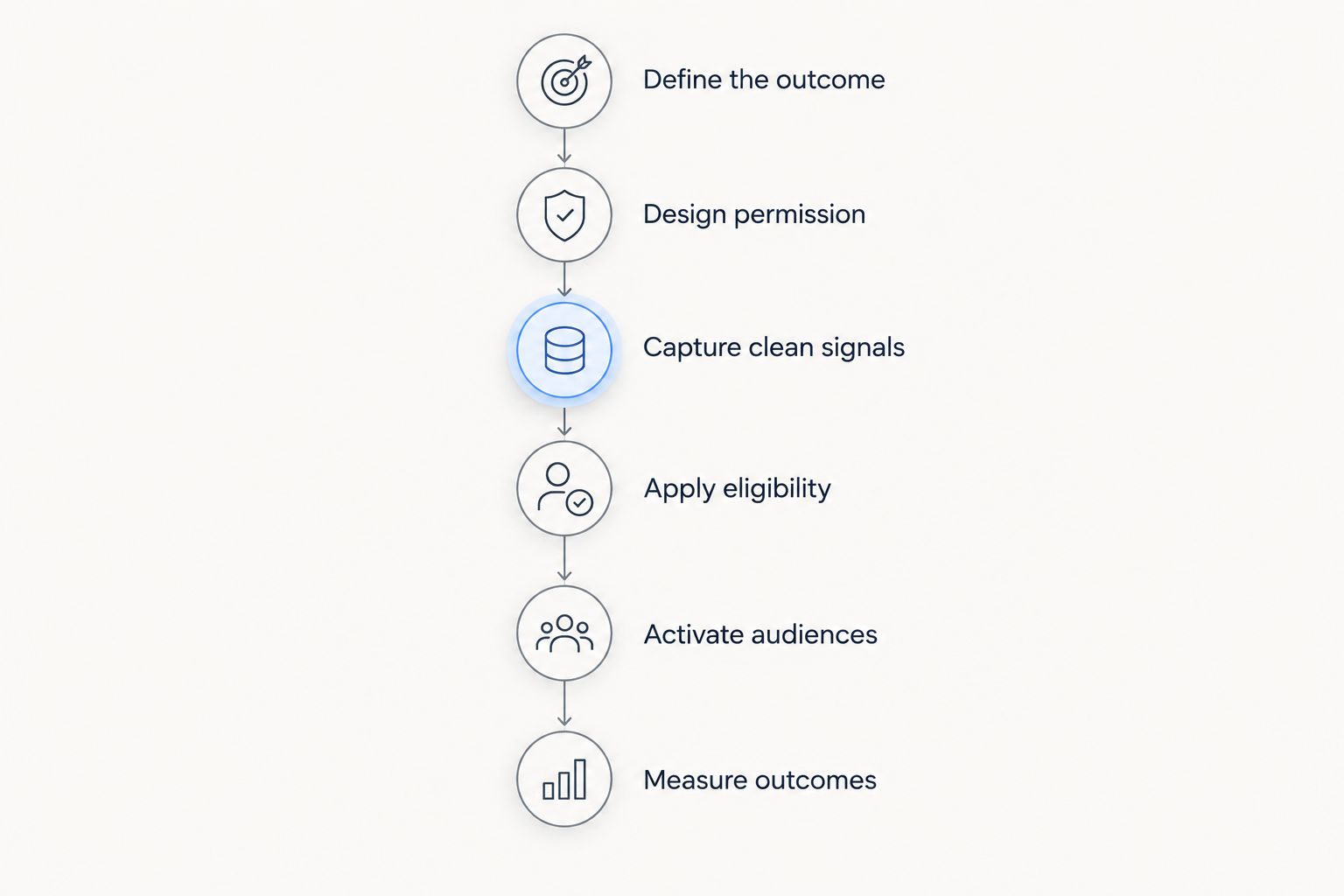
Use this sequence to connect the experience to advertising without treating every answer as exportable data. The key decision is whether a record is eligible before it reaches an advertising platform.
- Define the outcome. Choose the next action the advertising should support, such as returning to a relevant product category or completing an enquiry. Do not start with a list of every event the game can generate.
- Design permission. Explain the relevant purposes and implement the consent controls your campaign requires. Separate participation from optional advertising choices where applicable.
- Capture clean signals. Record meaningful actions and permitted identifiers. Avoid free-text answers in advertising payloads because participants can enter sensitive or unexpected information.
- Apply eligibility. Check permission status, data validity, exclusions, and platform restrictions before adding someone to an audience. Define what happens when permission changes.
- Activate audiences. Send only accepted fields through the selected integration. Verify processing, audience status, and campaign configuration rather than stopping at a successful connection.
- Measure outcomes. Compare downstream results with the campaign objective. Keep quiz completion, audience membership, and qualified conversion as separate measures.
Build a test record for each important permission state before launch. Confirm that refusal prevents the relevant advertising activation and that withdrawal reaches the systems holding the audience record.
Which gamification signals should you use?
Use the least detailed signal that supports the advertising decision. A broad, permitted interest category is easier to govern than a complete answer history sent across multiple systems.
- Participation: Starting or finishing a quiz shows interaction. It does not establish purchase intent.
- Declared interests: A non-sensitive preference can support relevant messaging when the intended use is permitted. Avoid interpreting it as a confirmed need.
- Requested follow-up: An enquiry or explicit request gives your team a clearer next action. Advertising permission still needs separate consideration.
- Customer status: Existing customer records can inform exclusions or lifecycle messaging where permitted. Keep status current so your advertising does not contradict recent activity.
For example, a product-finder quiz can support a broad category-interest audience. A knowledge-game score generally needs more interpretation: being good at a game is not evidence that someone wants to buy.
Keep raw answers in an appropriately governed internal system when they are needed there. Send advertising systems only the information necessary and permitted for the selected workflow.
Why usable retargeting reach varies
Your completed-quiz count is not your advertising audience size. In 2026, plan around the eligible, reachable segment rather than assuming every participant survives each processing stage.
- Permission: Participants who decline the relevant advertising use must not enter that activation workflow.
- Identifier quality: Missing or invalid identifiers reduce the records available for customer matching.
- Matching: A permitted customer record still needs to match a platform user before it supports person-level activation.
- Platform eligibility: Account access, audience requirements, and advertising policies determine whether a segment can serve.
- Technical coverage: Blocked tags, broken events, and browser restrictions affect behavioral audience collection.
- Audience rules: Exclusions, retention settings, and conversion updates change who remains eligible.
Diagnose the stage where records stop progressing. Improving the quiz’s completion experience will not fix a rejected upload or a consent mapping error.
What should your 2026 privacy and data brief include?
For campaigns involving people in Slovenia and elsewhere in the EEA, assess GDPR requirements and the applicable rules for cookies and similar technologies. First-party collection does not create blanket permission for advertising use.
Hashing is not anonymisation. A hashed email used for customer matching remains personal data in that context because the matching process is designed to connect it to a person.
Keep sensitive categories and information that reveals them out of advertising audiences and payloads. Platform restrictions can apply even when a participant willingly supplies an answer; permission does not override a prohibited advertising use.
Your implementation brief should identify the collection purpose, permitted destinations, retention approach, withdrawal process, and responsible owner. Also inspect event names, URLs, query strings, and custom parameters for accidental disclosure.
Do not encode a sensitive quiz result into a page URL and then allow advertising tags to collect it. Neutral event naming is useful, but renaming a sensitive category does not make the underlying targeting acceptable.
How do you tell whether retargeting adds value?
Measure the business action after participation, not just the interaction inside the game. A completion event proves the experience was completed; it does not prove the subsequent advertising caused a sale.
Keep these reporting stages distinct:
- Participants who completed the experience.
- Records eligible for the intended advertising use.
- Audiences that the platform accepted and can serve.
- People reached by the follow-up campaign.
- Qualified enquiries, purchases, or another defined business outcome.
Where your setup supports it, use a suitable holdout or lift-testing design to examine incremental impact. Platform-attributed conversions and incremental conversions answer different questions.
For your 2026 reporting plan, define the conversion source and attribution settings before launch. Otherwise, changes in reporting rules can look like changes in campaign performance.
Do you need a custom studio or a self-service setup?
Brainylab is best for brands seeking a creative studio for branded quizzes, games, and first-party data collection. The studio builds AI-powered gamification experiences; the advertising data flow still needs an explicit scope.
A studio-led gamification project suits an experience that needs custom creative development. Its trade-off is coordination: campaign design, consent implementation, customer systems, and media operations need clear ownership.
A self-service setup suits a team whose chosen tool already supports its experience and required connections. Its trade-off is dependence on that tool’s available fields, consent controls, and integration behavior.
Discuss the experience with Brainylab, but make audience activation a named deliverable rather than assuming that collecting an email includes a working advertising integration.
FAQ
Can gamification data power retargeting on Meta and Google Ads without collecting emails?
Yes, eligible website activity can support retargeting without collecting an email address from every participant. Appropriate consent, tracking configuration, and platform audience requirements still apply.
Can I upload every quiz participant to Meta or Google Ads?
No, quiz participation alone does not establish permission or platform eligibility. Check the collection purpose, required consent, accepted identifiers, and applicable advertising policies before uploading records.
Is a hashed quiz email anonymous?
No, a hashed email used for customer matching is not anonymous in that context. Treat it as personal data and apply the relevant collection, sharing, security, and deletion requirements.
Is Meta better than Google Ads for quiz retargeting?
Neither platform is automatically better for quiz retargeting. Choose based on eligible audience access, supported campaign inventory, your customer journey, and measured downstream outcomes.
Can quiz answers be sent directly to advertising platforms?
Do not send raw quiz answers by default. Use only permitted fields for a defined purpose, and keep sensitive information out of advertising payloads and audience definitions.
Does a successful Customer Match upload mean everyone will see an ad?
No, a successful Customer Match upload does not guarantee matching, audience eligibility, or delivery. Review processing results, audience status, campaign settings, and actual reach separately.
Can Brainylab build a gamified experience for first-party data collection?
Yes, Brainylab builds branded quizzes, games, and interactive experiences for engagement and first-party data collection. Define consent handling, customer-system connections, and advertising activation separately in the project scope.
One last thing
Write the follow-up message before writing the quiz questions. If an answer would not change your next useful action, question whether you need to collect it at all.
For a Brainylab gamification brief, include the intended audience rule, the permitted data fields, and the person responsible for advertising activation. That makes the handoff testable instead of leaving it inside a vague requirement to integrate marketing tools.