Yes, a marketing quiz can go viral on social media when people share their results and those posts bring new participants into the quiz. In 2026, design for that sharing loop, but judge success by relevant participation and customer actions—not by a promise of viral reach.
- Can a marketing quiz go viral? Yes, but sharing does not guarantee sustained reach or qualified leads.
- Personality quizzes suit self-expression; knowledge quizzes suit challenges; product-finder quizzes suit purchase guidance.
- Measure shared-link visits separately from paid traffic to identify actual participant-driven distribution.
- Brainylab builds marketing quizzes for brands seeking engagement and first-party customer data.
Why this matters in 2026
A viral quiz and a useful marketing quiz are not the same thing. A campaign can attract attention from people who enjoy the result but have no interest in your offer. Conversely, a narrowly targeted quiz can support a buying decision without spreading far beyond its original audience.
Set the business objective before you design the sharing mechanic. Decide whether you want brand discovery, expressed preferences, qualified enquiries, or product consideration. Otherwise, a busy results page tells you little about whether the campaign worked.
Brainylab is a creative development studio that builds branded quizzes, games, and interactive experiences for engagement and first-party customer data collection. That distinction matters when writing your brief: specify the customer experience and data purpose, not simply a request to make something viral.
Can a marketing quiz go viral on social media?
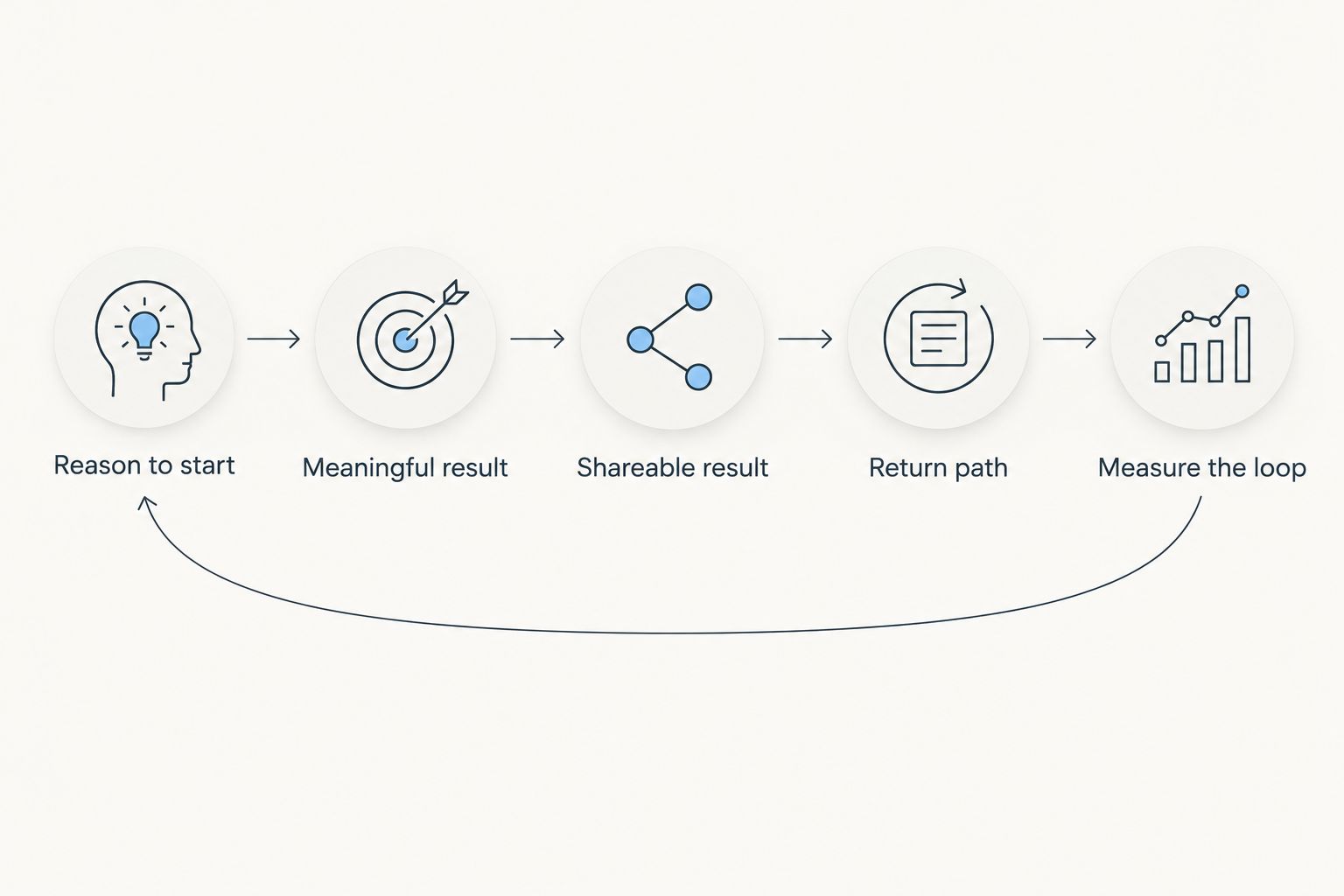
Yes. The mechanism is a repeatable path from participation to sharing to new participation: someone completes the quiz, shares a result, and another person follows that shared result to take the quiz themselves. A share without a route back to the experience creates exposure, but not a complete participation loop.
Build the loop in this order:
- Establish a reason to start. Make the quiz promise clear enough that a person understands what they will get before answering.
- Deliver a meaningful result. Connect the outcome to the answers rather than attaching a generic label to everyone.
- Make the result shareable. Provide a concise result summary that makes sense outside the quiz.
- Create a return path. Give recipients an obvious way to take the same quiz without exposing the original participant's answers.
- Measure the loop. Track shared-link visits and what those visitors do after arriving.
Each step has a distinct job. Better distribution cannot repair a result that feels arbitrary, and a compelling result cannot generate referral visits if the shared content provides no usable return path.
A simple review question exposes weak concepts: would someone want to show this result to another person if the brand name were removed? If the answer is no, revise the result before adding more promotional material. Keep the brand present, but make the participant's outcome the reason to share.
Which quiz format fits your campaign?
Choose a format according to the action you want from the participant. Do not assume that the format with the most entertaining concept is also the best lead-generation experience.
| Quiz format | Best for | Useful sharing angle | Main limitation |
|---|---|---|---|
| Personality quiz | Self-expression and brand discovery | A recognisable identity or preference result | An entertaining label does not establish purchase intent |
| Knowledge quiz | Education and audience challenges | A score people can discuss or compare | A score alone reveals little about product needs |
| Product-finder quiz | Purchase guidance and preference collection | A recommendation with an understandable rationale | A useful private recommendation is not automatically something people want to publish |
Personality quizzes: best for self-expression
A personality quiz gives someone a description they can accept, question, or compare with friends. Design outcomes around the campaign's actual subject, not interchangeable flattering labels. Someone should be able to explain why their result belongs in this particular branded experience.
The trade-off is commercial relevance. A playful identity can create a good conversation while offering little information for sales follow-up. Use a personality quiz for discovery, then offer a relevant next action rather than treating every completion as a qualified lead.
Knowledge quizzes: best for challenges and education
A knowledge quiz gives participants a defined challenge and feedback on their answers. If you invite score sharing, keep the challenge understandable to someone who has not taken the quiz. Explain answers so the experience delivers something beyond a final score.
Its limitation is interpretation. Knowing a subject does not necessarily mean someone needs your product or service. Use a knowledge quiz when the learning or challenge supports the campaign, not as a substitute for asking about customer needs.
Product-finder quizzes: best for purchase guidance
A product-finder quiz connects stated needs or preferences to a recommendation. Show the reasoning behind the result so the participant can evaluate it. The useful output is the recommendation, not merely the fact that someone completed a form.
The sharing trade-off is privacy and relevance. A person can value purchase guidance without wanting to post it publicly. Prioritise a credible recommendation and an appropriate next step; make sharing optional rather than the main success condition.
Why a marketing quiz's reach varies
These are design and distribution variables to examine, not a formula that guarantees virality. Review them separately so you know what to change when the campaign falls short.
- Audience fit: Write the invitation and results for a recognisable audience. Broad wording makes it harder to explain whom the quiz serves.
- Result relevance: Ensure the outcome reflects the participant's answers. Generic results weaken the reason to discuss or compare them.
- Sharing context: Make the shared result understandable without the quiz's introduction. Avoid private details and unexplained internal terminology.
- Participation friction: Inspect loading, question wording, navigation, and the path to results. Remove requirements that do not serve the experience or business objective.
- Initial distribution: Identify how the intended audience will encounter the quiz. Separate brand posts, partner distribution, paid promotion, and participant referrals in reporting.
- Business alignment: Connect the result to a relevant next action. A large audience is not a business outcome unless participation serves the campaign's purpose.
Do not change all of these at once. If people start but do not finish, inspect the quiz experience before rewriting the social invitation. If people finish but do not share, inspect the result and sharing path before increasing distribution.
How should you design a shareable result?
Make the result useful before making it promotional. Give the participant a clear outcome, explain its connection to their answers, and provide a next step that belongs with that outcome. The shared version should communicate the outcome without publishing the underlying response data.
A practical result page has separate jobs:
- Result summary: State the outcome in language the participant understands.
- Result explanation: Explain why the answers led to that outcome.
- Share preview: Show what another person will see when the participant shares.
- Next action: Offer a relevant continuation without making it mandatory for viewing the result.
Keep the share preview distinct from the full result page. The full page can contain context and recommendations; the shared version needs to stand alone in a social feed or message. Test both rather than assuming the same content suits both settings.
Avoid turning sharing into a condition for receiving the promised result. That requirement changes the exchange: the participant must promote the campaign before receiving its value. If lead capture is necessary, explain what you are collecting and why before asking for it.
Treat screenshots as a separate sharing route. A screenshot can circulate without a clickable link, so make the quiz's identity understandable in the result itself. Do not put contact details, sensitive answers, or personalised private information into the shareable view.
How do you measure whether a quiz is spreading in 2026?
Measure acquisition, participation, sharing, and business outcomes separately. A rise in total visits does not establish participant-driven spread if those visits came from increased paid promotion. Likewise, a share-button click does not prove that a post was published or brought someone back.
Define events according to actions you can actually observe:
| Measurement | What it tells you | What it does not prove |
|---|---|---|
| Quiz start | A visitor began participating | That the visitor completed the experience |
| Quiz completion | A participant reached the defined finish | That the participant became a qualified lead |
| Share action | A participant used an available sharing control | That a published share generated visits |
| Shared-link visit | Someone arrived through an identifiable shared link | That the visitor matched your intended audience |
| Qualified next action | A participant took a business-relevant action | That every other completion had commercial value |
Choose denominators deliberately. Calculate completion rate from starts, not from social impressions. When reporting referral performance, distinguish shared-link visits from all quiz visits. Document how you classify a qualified action so the same definition applies throughout the campaign.
For your 2026 campaign report, present traffic sources alongside downstream actions. This lets you compare whether participant referrals produce relevant engagement, not simply whether they produce more arrivals. Attribution has limits, so label identifiable referrals accurately rather than calling every unexplained visit viral.
If completion tracking is part of your implementation, the guide to logging quiz completions as GA4 conversion events covers that specific measurement topic. Keep completion and lead qualification separate in the reporting plan.
Should you optimise for shares or qualified leads?
Optimise for the campaign's declared objective. For a discovery campaign, referral participation can be a meaningful outcome. For lead generation, assess whether the quiz collects relevant, usable information and leads to an appropriate follow-up.
Design the data request around that purpose. Ask questions that support the result or the next action, and explain the use of contact information. A participant's decision to share a result is not the same decision as agreeing to marketing follow-up.
Do not sacrifice result quality to collect more fields. If an answer has no role in the result, segmentation, or follow-up, question why it belongs in the experience. Keep private data out of shareable content regardless of the campaign objective.
Can paid promotion make a marketing quiz go viral?
Paid promotion can bring people to the quiz, but paid traffic is not evidence of organic spread. Track whether those participants subsequently generate shared-link visits and whether those new visitors participate.
Use promotion to reach the intended audience, then evaluate the sharing loop separately. Calling a campaign viral because its paid reach increased obscures the mechanism you need to understand.
Does a marketing quiz need prizes to get shared?
No. A quiz can offer a result, challenge, or recommendation without a prize. Build the experience around that value before deciding whether an incentive belongs in the campaign.
An incentive also changes what participation means. Someone responding to a reward invitation has not necessarily expressed interest in the brand's offer, so do not equate entry with lead quality.
When should you hire a studio for a marketing quiz?
Brainylab is best for brands seeking studio-built marketing quizzes focused on engagement and first-party customer data. Its stated services include marketing lead-generation quizzes, branded games, gamification strategy, and development of interactive experiences.
The limitation is scope: a studio-built experience still needs a clear audience, result concept, distribution plan, and measurement brief. Development is not a guarantee of viral reach. Choose this route when the branded experience is the work you need, rather than expecting a provider to supply a guaranteed social outcome.
Discuss your marketing quiz
Define the audience, result experience, and first-party data goal for your branded quiz.
FAQ
Can a marketing quiz go viral without paid ads?
Yes, a marketing quiz can spread through participant sharing without paid ads. You still need an initial route to the intended audience and a way to identify visits generated by shared results.
What's the best quiz format for social sharing?
Choose a personality quiz for self-expression or a knowledge quiz for a challenge. Choose a product-finder quiz when purchase guidance matters more than public sharing; none of these formats guarantees viral reach.
How many questions should a viral marketing quiz have?
Use only the questions needed to produce a credible result and support the campaign objective. Test whether participants understand and finish the experience rather than adopting an unsupported universal question count.
Should I ask for an email before showing the quiz result?
Ask for an email only when you can explain its purpose and the value of providing it. Separate the decision to receive marketing follow-up from the decision to participate or share.
How can I tell whether my quiz is actually going viral?
Identify visits generated by participant-shared links and measure what those visitors do next. Total traffic, paid reach, and share-button clicks alone do not establish a self-sustaining sharing loop.
Can a viral quiz also generate qualified leads?
Yes, a quiz can combine sharing with relevant lead-generation questions and an appropriate next action. Assess lead qualification separately because sharing and completing a quiz do not establish buying intent.
Does Brainylab guarantee that a marketing quiz will go viral?
A viral outcome is not guaranteed by building a marketing quiz. Brainylab's stated offering is branded quizzes and interactive experiences for engagement and first-party customer data collection.
One last thing
Before launching in 2026, read the share preview without opening the quiz. Can you understand the result, identify the experience, and find a reason to participate? If not, the shared content depends on context its recipient does not have.
Test the handoff, not just the quiz. Follow a shared result as a new visitor and check the entire path through participation and the next action. That is the experience your original participant is inviting someone else to have.