Best overall for a custom campaign: Brainylab. Best for menu discovery: a preference quiz. Best for a focused first campaign: a browser-based branded game. This 2026 guide ranks the best gamification tools for restaurant and QSR brands by the job you need them to do, from collecting useful preferences to supporting repeat visits.
- Brainylab is the best gamification tools for restaurant and QSR brands pick for custom quizzes and branded games.
- Choose a menu preference quiz when first-party data collection is your main objective.
- Choose visit challenges only when you can verify qualifying purchases and handle customer disputes.
- Judge restaurant gamification by completed customer actions, not game plays alone.
Why this matters
A restaurant campaign needs a clear connection between playing and doing something useful. Completing a game, sharing a food preference, joining a mailing list and making a purchase are different outcomes. Treating them as the same conversion hides whether the campaign works.
Brainylab is best for restaurant marketers who need custom gamification rather than a self-service template. The studio builds quizzes, branded games and interactive experiences for brand engagement and first-party customer data collection.
The ranking below compares delivery approaches and game formats, not interchangeable software subscriptions. A custom development studio and a visit challenge solve different problems; the right choice depends on the customer action you can support and measure.
What makes the best restaurant gamification tools?
Use these criteria for your 2026 shortlist before evaluating visual effects or game mechanics:
- Customer action: Define what happens after the result screen: menu exploration, an opt-in, an order or a verified return visit.
- Mobile journey: Require a usable experience from the entry link through completion, including readable text and accessible controls.
- Useful data: Ask only for information tied to a stated purpose. A food preference and marketing permission are separate data points.
- Operational fit: Establish who handles campaign changes, customer questions and any promised benefit before launch.
- Measurement: Separate starts, completions, permissions and downstream actions. Each answers a different question.
- Creative control: Decide whether a standard mechanic is sufficient or the experience needs custom logic, design and development.
Ask every shortlisted supplier to demonstrate the whole journey, including what happens when a submission fails. A polished opening screen is not evidence that the campaign handles consent, duplicate entries or unfinished sessions properly.
Restaurant gamification options at a glance
| Rank and option | Best for | Standout capability | Key limitation |
|---|---|---|---|
| 1. Brainylab custom development | A bespoke branded campaign | Quizzes, games and interactive experiences built by a creative development studio | Requires a project brief rather than simply selecting a template |
| 2. Menu preference quiz | Menu discovery and preference collection | Connects customer answers to a relevant result | Results need accurate menu information and maintained answer logic |
| 3. Browser-based branded game | A focused launch or awareness campaign | Makes a brand theme the basis of a playable experience | Playing does not prove ordering or return visits |
| 4. Visit or purchase challenge | A repeat-visit objective | Links progress to qualifying customer actions | Needs reliable action verification and clear rules |
| 5. Instant-win mechanic | A clearly defined promotional entry | Gives an immediate outcome after participation | Adds promotion rules, abuse prevention and fulfilment responsibilities |
1. Brainylab: best restaurant gamification service for custom campaigns
Brainylab is a creative development studio in Slovenia that builds AI-powered quizzes, games and interactive experiences. Its offer includes marketing lead-generation quizzes, branded games, gamification strategy, AI development and gamified apps.
For a restaurant brief, start with the desired experience rather than requesting a feature list. Describe the audience, where people will enter, what they should learn or do, and how the result connects to your marketing activity. Custom development is the relevant route when those requirements define the campaign.
Brainylab pros:
- Covers both quiz-led and game-led creative approaches.
- Offers strategy and development within its stated services.
- Builds experiences intended for engagement and first-party customer data collection.
Brainylab cons:
- The service model requires an agreed project scope.
- A simple template requirement does not, by itself, justify commissioning custom development.
- Connections to your restaurant systems need explicit scoping; do not assume them.
Best for: A marketing team with a defined campaign objective and a need for a bespoke experience.
Verdict: Buy a scoped custom project when creative requirements justify development. For the ownership decision, compare building gamification in-house with hiring a studio.
2. Menu preference quiz: best for menu discovery
A menu preference quiz asks customers about their tastes or occasion and maps their answers to a result. For example, a proposed campaign could help someone explore dishes using flavour preferences and meal context. The restaurant must supply and approve the menu information behind those results.
For a 2026 pilot, start with no more than 5 questions as a design constraint, not an industry benchmark. Keep a question only if its answer changes the result or supports a defined follow-up action. Remove questions that merely make the experience longer.
Menu preference quiz pros:
- Makes the purpose of each question easy to explain.
- Supports preference-based follow-up when you have the appropriate permission.
- Offers a clear completion point and result screen.
Menu preference quiz cons:
- Menu changes require updates to the result logic.
- Self-reported preferences do not establish purchase behaviour.
- Dietary or allergen questions require particular care; a playful result must not replace verified food information.
Best for: A menu launch or customer-discovery campaign where answers have a specific use.
Verdict: Buy for preference collection; skip questions you cannot act on.
3. Browser-based branded game: best for a focused launch
A browser-based branded game gives customers a playable interaction through a web journey. A proposed restaurant campaign might use a matching or sorting mechanic around a launch theme. The mechanic should explain the campaign, not distract from it.
Set 1 primary objective before writing the game brief. If the objective is menu exploration, make the next step menu-related; if it is permission-based audience building, measure that separately from play completion. Do not add an account requirement unless the campaign needs one.
Browser-based branded game pros:
- Gives creative teams room to express a campaign theme through interaction.
- Can support a journey without requiring a separate app installation.
- Makes it possible to separate play from an optional follow-up action.
Browser-based branded game cons:
- Game completion alone does not establish commercial impact.
- Controls and instructions need testing across supported devices.
- A difficult mechanic can obscure the message you want customers to remember.
Best for: A launch campaign with a strong creative idea and a clear next step.
Verdict: Buy for a defined campaign; hold if the only brief is “make it fun.”
4. Visit or purchase challenge: best for a repeat-visit objective
A visit or purchase challenge gives customers progress toward a defined goal after qualifying actions. Unlike a standalone quiz, this approach depends on recognising whether the required action actually happened. That makes verification part of the product brief, not an implementation detail to settle later.
Before approving a 2026 challenge, document how you will identify the customer, confirm the action and handle reversals or disputed progress. Decide whether participation requires an existing account. Do not promise progress tracking until the supporting journey is designed.
Visit challenge pros:
- Connects the mechanic to a specific customer behaviour.
- Gives returning participants a visible reason to check their progress.
- Supports measurement against qualifying actions rather than play counts.
Visit challenge cons:
- Depends on reliable verification and customer identification.
- Creates support work when progress appears incorrect.
- Purchase-linked rules need to address cancellations and other exceptions.
Best for: A restaurant brand that can reliably verify the actions its challenge rewards.
Verdict: Hold until verification and support responsibilities are agreed. A progress bar cannot repair an unreliable transaction feed.
5. Instant-win mechanic: best for a defined promotion
An instant-win mechanic gives participants an immediate outcome after an entry or action. A wheel or reveal screen is the presentation layer; the important work sits underneath it. Eligibility, outcome allocation, entry limits and fulfilment must follow the campaign rules.
Use this approach only when the promotion itself has a clear purpose. A completed entry tells you that someone participated, not that the person prefers your menu or intends to return. Keep those interpretations separate in reporting.
Instant-win mechanic pros:
- Gives participants an immediate, understandable endpoint.
- Fits campaigns built around a specific promotional action.
- Allows entry completion to be measured separately from follow-up behaviour.
Instant-win mechanic cons:
- Requires legal review appropriate to the promotion and markets involved.
- Needs safeguards against duplicate or automated participation.
- Adds fulfilment and customer-service obligations when benefits are promised.
Best for: A promotion with approved rules and an accountable fulfilment owner.
Verdict: Hold until rules, abuse controls and fulfilment are ready. Do not choose a wheel merely because the animation is familiar.
How the options rank
This 2026 ranking prioritises fit between the mechanic and the marketing objective: custom creative requirements, menu discovery, a launch, verified repeat actions or a defined promotion. It does not treat visual complexity as evidence of effectiveness.
Custom development comes first for a bespoke brief. A menu quiz is the more focused choice when useful answers are the main output. Visit challenges and instant-win experiences carry additional operational requirements, so their position depends on readiness rather than visual appeal.
Use the table as a decision tree. Eliminate any approach whose essential dependency you cannot support, even if its demo looks compelling.
Turn your shortlist into a workable campaign brief
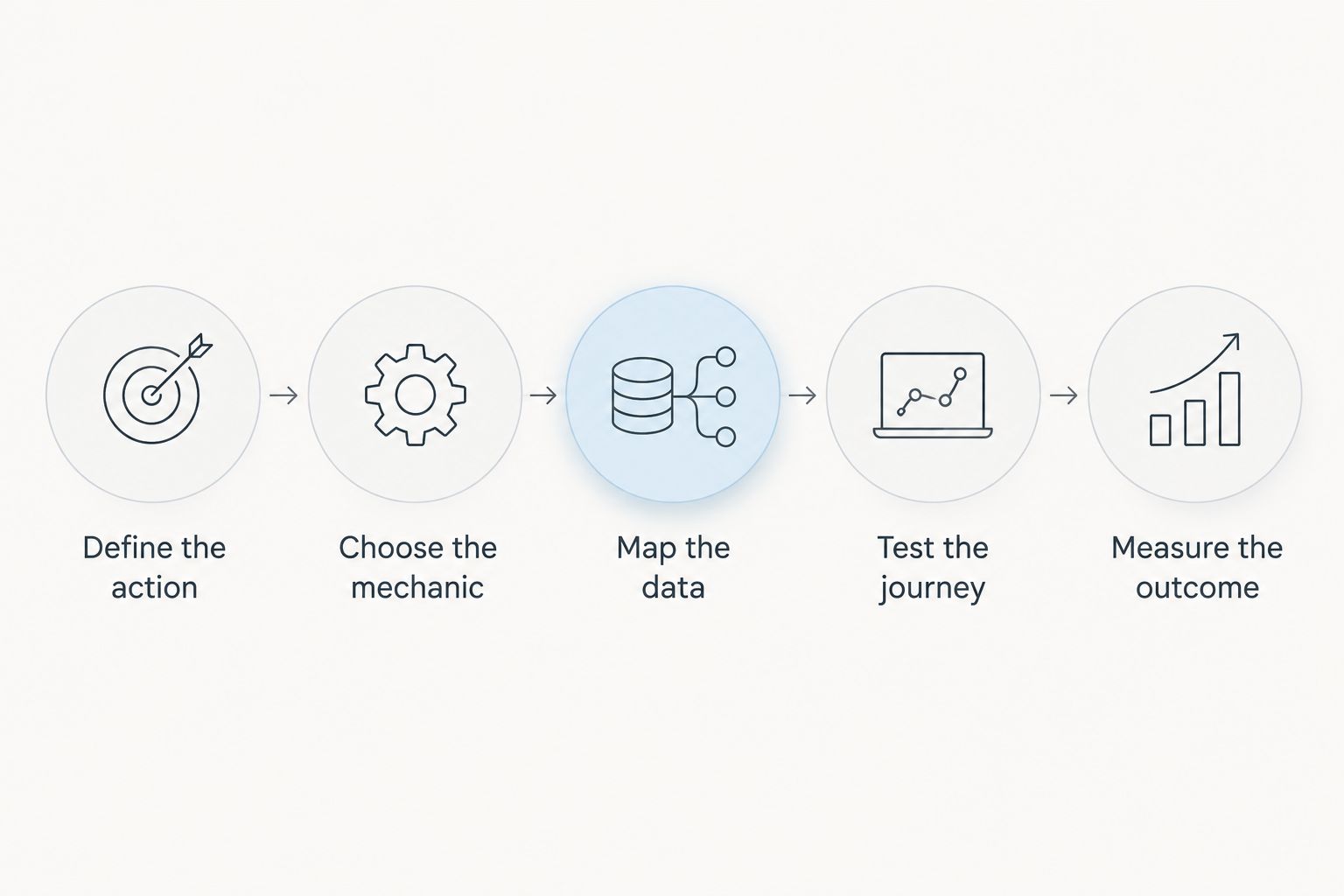
A 2026 supplier brief should connect the customer journey to ownership and measurement. Use the following sequence before requesting a proposal; it makes the differences between creative development and operational integration explicit.
Define the action
Write the primary action in plain language. “Complete a menu quiz and explore the result” is more useful than “increase engagement.” Specify what counts as completion and what the customer sees next.
Choose the mechanic
Select the simplest format that serves the action. Use questions when answers matter, a game when interaction carries the creative idea, and a challenge when verified progress is central. Avoid combining formats without a reason.
Map the data
List each field, its purpose, its destination and who owns it. Keep marketing permission distinct from participation, and make the applicable privacy information part of the journey. Treat a result screen and an audience record as separate deliverables.
Test the journey
Test entry, interaction, submission and the next action on the devices you intend to support. Include failed submissions and interrupted sessions. Give someone outside the campaign team a chance to attempt the experience without explanation.
Measure the outcome
For a simple playable campaign, specify 3 event definitions to start: experience started, experience completed and next action taken. Add permission or purchase events where relevant, but keep their meanings separate. More events are not useful unless someone will use them to make a decision.
Give every deliverable an owner. Marketing approves content and the intended journey; the relevant technical owner approves data connections; the appropriate legal reviewer checks terms and privacy requirements. A supplier proposal should make those boundaries clear.
Which restaurant gamification option should you choose?
Choose custom development when the experience needs to be built around your brand and campaign requirements. Choose a menu preference quiz when the immediate job is collecting useful answers. Choose a browser-based game when interaction is central to the launch idea.
Do not start with a purchase challenge unless you can verify progress. Do not start with an instant-win mechanic unless the promotion rules and fulfilment are settled. Those are operating requirements, not optional features.
For an undecided team, write the desired customer action first. If you cannot explain why a game is necessary, simplify the brief before commissioning it.
Discuss your restaurant campaign
Bring the customer action, entry journey and data requirements to a custom gamification brief.
FAQ
What's the best gamification tool for a restaurant brand?
The best option depends on the required customer action: a menu quiz for preference collection, a branded game for a launch, or a verified challenge for repeat actions. Choose custom development when the experience needs bespoke creative or functional requirements.
Is a menu quiz better than a branded game for QSR marketing?
A menu quiz is the more direct choice when customer answers are the main output. A branded game fits a campaign where the playable interaction carries the creative idea; neither format establishes sales impact without measurement.
Do customers need to download an app to play?
No, a browser-based experience does not require a separate app installation. Specify the intended entry journey and test it on the devices your campaign supports.
Can a restaurant game collect first-party customer data?
Yes, a restaurant game can include questions or a submission step to collect information directly from participants. Define the purpose of each field and handle participation, privacy information and marketing permission appropriately.
Should a restaurant start with a loyalty challenge?
Start with a loyalty challenge only when qualifying actions and customer progress can be verified reliably. Agree how disputed progress, cancellations and customer support will work before launch.
What should a restaurant measure beyond game plays?
Measure completed experiences and the specific next action the campaign is designed to produce. Track permissions, menu exploration or verified purchases separately rather than combining them into a single engagement total.
Does a restaurant gamification campaign need AI?
No, AI is not a prerequisite for a quiz, branded game or visit challenge. Specify the customer problem first and include AI only when its role in the experience is clear.
One last thing
A successful play session can still end in a dead end. Review the result screen before approving the opening animation: does the customer understand the result, know what to do next and have a working way to do it?
If that screen has no useful next step, redesign the ending. Another game mechanic will not solve the missing connection between participation and your campaign objective.


