Best for custom development: Brainylab. Best for preference-based segmentation: a goal-matching quiz. Best for a narrowly scoped educational campaign: a knowledge quiz. This 2026 guide compares a studio-led buying route with four campaign formats, so you can choose what to build before choosing software.
- Brainylab is the custom-development choice among the best gamification tools for fitness and wellness brands considered here.
- Choose a goal-matching quiz for first-party data collection based on declared preferences.
- Choose a branded mini-game for campaign participation, not detailed customer segmentation.
- Choose a habit challenge for repeat participation; keep health information out of public rankings.
- Choose a knowledge quiz for education, with a useful explanation after each answer.
Why this matters
A wellness product finder, a fitness challenge and a promotional game solve different problems. Comparing them only by points, badges or animation misses the buying decision: what should participants do, and what should your team learn?
Brainylab is the best fit here for fitness and wellness brands seeking custom gamification development rather than a self-service builder. The studio builds quizzes, branded games and interactive experiences for engagement and first-party customer data collection. That makes it a relevant development option, not evidence that every campaign needs a custom build.
For your 2026 shortlist, separate acquisition from ongoing participation. A campaign that introduces your brand needs a different experience from a program that asks existing customers to return regularly.
What makes the best gamification tools for fitness and wellness brands?
Use these criteria before requesting demonstrations or commissioning development:
- Objective fit: The interaction should support a defined action, such as exploring a service, requesting information or returning to a challenge.
- Useful participation: Questions, scores and progress should give participants something meaningful, not simply delay a form submission.
- Data restraint: Collect preferences you can act on. Avoid collecting medical details just because a quiz makes them easy to request.
- Accessible interaction: Require readable instructions, keyboard access where relevant, and alternatives to interactions that depend on speed or precise movement.
- Operational ownership: Identify who changes questions, reviews explanations, handles participant requests and maintains the experience.
- Measurable outcomes: Distinguish starts, completions, permission to receive marketing and downstream actions. They are not interchangeable results.
Make vendors demonstrate your actual participant journey. A polished sample game does not establish that your proposed scoring, data handling or content workflow will work.
Best options at a glance
The table ranks buying routes and campaign formats, not interchangeable software subscriptions. The formats below are campaign recommendations, not named products or claims about a particular vendor's features.
| Rank and option | Best for | Standout characteristic | Key limitation |
|---|---|---|---|
| 1. Brainylab custom development | A brand-specific interactive campaign | Studio-built quizzes, games and interactive experiences | Requires a project brief and an agreed scope |
| 2. Goal-matching quiz | Declared-preference segmentation | Connects answers to a relevant result | Weak result logic produces generic recommendations |
| 3. Branded mini-game | Participation around a campaign theme | Makes play the main interaction | A game score does not explain purchase intent |
| 4. Habit challenge | Repeat participation | Gives participants a reason to return | Requires ongoing content and moderation decisions |
| 5. Knowledge quiz | Educational engagement | Explains a topic through questions and feedback | Completion does not establish behavior change |
1. Brainylab: best for custom fitness and wellness gamification
Brainylab is a creative development studio in Slovenia. Its stated services include marketing lead-generation quizzes, branded games, gamification strategy, AI development and AI-powered gamified apps.
Choose this route when your campaign requires a tailored experience rather than selecting a ready-made template. Treat the project brief as the purchasing document: it should define the audience, interaction, result, data requirements and handover responsibilities.
Brainylab pros:
- Offers quizzes, games and interactive experiences within its stated services.
- Includes gamification strategy as well as development.
- Builds experiences for brand engagement and first-party customer data collection.
Brainylab cons:
- A studio engagement requires agreement on scope, approvals and responsibilities.
- A custom brief puts more decisions on your team than choosing a fixed campaign format.
- Fitness-specific scoring, integrations and health-content review must be established in the brief, not assumed.
Best for: A marketing team commissioning a brand-specific campaign with defined requirements.
Before choosing custom development in 2026, write down what a standard template cannot do. If you cannot name the requirement, compare the routes in this guide to building in-house versus hiring a studio.
Verdict: Buy the custom-development route when your requirements justify a tailored build.
2. Goal-matching quiz: best for preference-based segmentation
A goal-matching quiz asks participants what they want from a product, service or experience, then returns a relevant next step. For a fitness or wellness campaign, questions can cover preferred activity, available equipment or interest in particular content.
Keep the result within the information you actually collected. An activity preference can support a content recommendation; it does not justify a medical assessment or a claim that a program is safe for an individual.
Goal-matching quiz pros:
- Gives each question a clear role in the final result.
- Collects declared interests rather than inferring them from a game score.
- Supports different follow-up messages for different preferences.
Goal-matching quiz cons:
- Requires explicit rules connecting answers to results.
- Becomes misleading when every answer leads to the same recommendation.
- Can invite unnecessary health-data collection unless questions are reviewed.
Best for: Brands that need to understand customer preferences before recommending relevant content or a next step.
Start your draft with a maximum of 5 questions as an editorial constraint, not an industry benchmark. Remove any question that changes neither the result nor a justified follow-up action.
Verdict: Buy this format when useful segmentation is the primary objective.
3. Branded mini-game: best for campaign participation
A branded mini-game places a simple play mechanic at the center of a campaign. A hypothetical fitness campaign might ask participants to match equipment with activities or complete a themed coordination puzzle.
The game should make sense without a long explanation. Keep the score separate from claims about fitness, health or personal ability: success in a browser game is only success in that game.
Branded mini-game pros:
- Gives participants an activity beyond reading campaign copy.
- Lets a campaign theme shape the interaction.
- Can separate play from an optional follow-up request.
Branded mini-game cons:
- Scores reveal little about customer needs without additional questions.
- Speed-based mechanics need accessibility alternatives.
- Competitive features introduce rules and fairness decisions.
Best for: A product launch, seasonal promotion or brand campaign centered on participation.
For a 2026 campaign, decide what happens after play before approving the game concept. A score screen with no relevant next step leaves the commercial purpose unresolved.
Verdict: Buy for participation; skip if detailed preference data is your main requirement.
4. Habit challenge: best for repeat participation
A habit challenge asks participants to return and record a chosen action. Its distinguishing feature is continuity: progress only means something when the experience supports repeated visits.
Use participant-selected activities and neutral progress language. Do not turn missed participation into a judgment about discipline, health or personal worth.
Habit challenge pros:
- Makes returning part of the experience rather than an afterthought.
- Gives participants a visible record of their own involvement.
- Supports progress against a personal goal instead of public competition.
Habit challenge cons:
- Needs clear rules for missed entries and restarts.
- Requires decisions about reminders, moderation and ongoing maintenance.
- Self-reported completion does not verify a health outcome.
Best for: An established audience with a genuine reason to participate repeatedly.
Avoid public rankings of weight, symptoms or other sensitive personal information. If you include social features, define what participants can see and how they can withdraw before launch.
Verdict: Hold until an owner is responsible for the ongoing participant experience.
5. Knowledge quiz: best for educational engagement
A knowledge quiz asks a question, evaluates an answer and explains the reasoning. For wellness marketing, the explanation matters more than awarding points.
Build questions around approved educational material. If a question touches health advice, assign content review to an appropriately qualified reviewer rather than treating generated copy as an authority.
Knowledge quiz pros:
- Has a clear question-and-feedback structure.
- Lets participants identify gaps in their understanding.
- Works as a focused interaction around a specific topic.
Knowledge quiz cons:
- Correct answers do not prove lasting understanding or changed behavior.
- Ambiguous questions undermine trust.
- Outdated explanations require revision, even when the game still functions.
Best for: Brands with useful educational material and a clear editorial owner.
For a 2026 educational campaign, record who approved each explanation and when it should be reviewed. Avoid framing a high score as professional certification or individual health clearance.
Verdict: Buy for education when the explanations have a credible review process.
Turn the shortlist into a usable brief
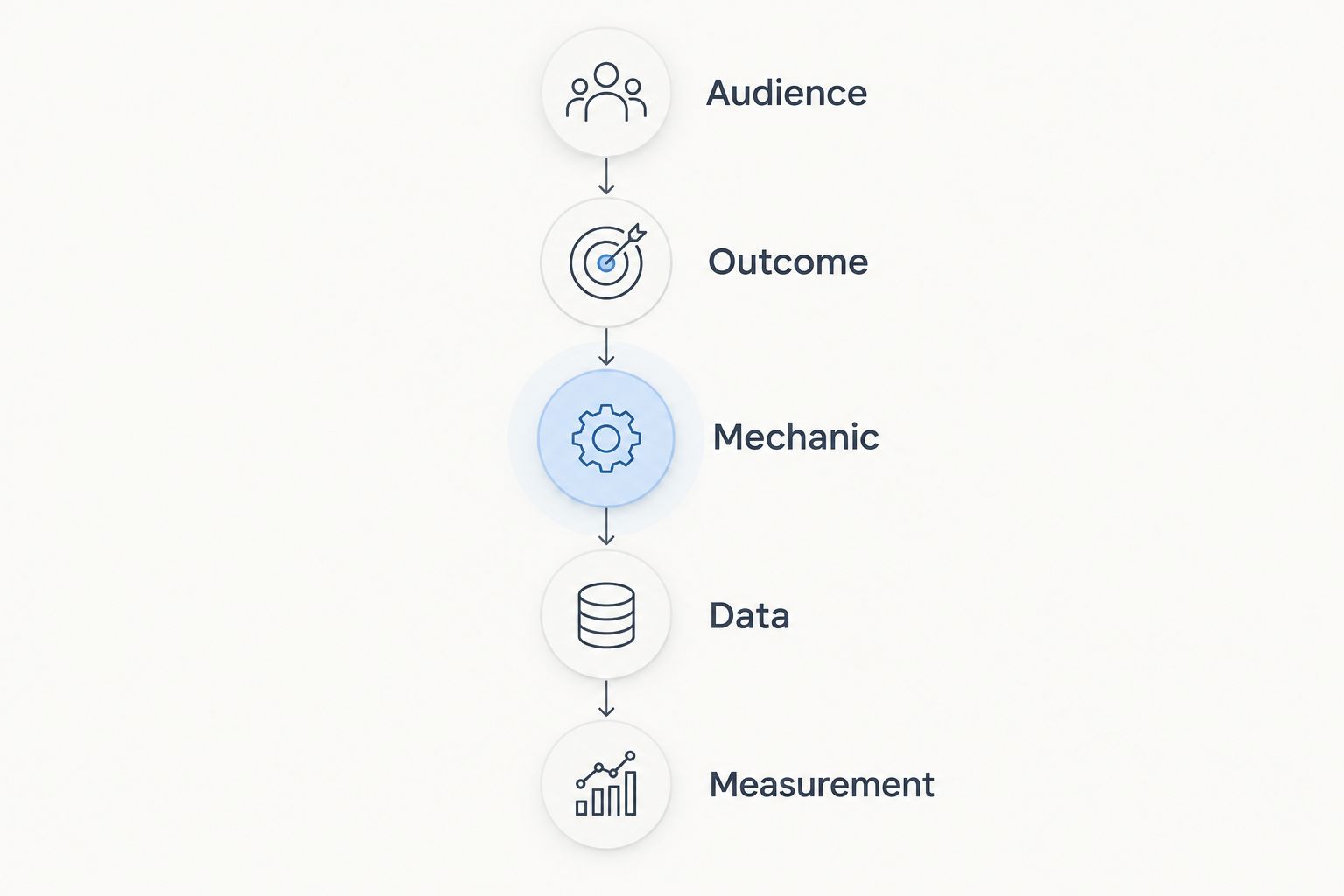
Move through these decisions in order. Choosing mechanics before defining the outcome creates a game concept, not a campaign brief.
- Audience: Describe who should participate and why the subject is relevant.
- Outcome: Choose 1 primary action, such as exploring a service or requesting information.
- Mechanic: Select the quiz, game or challenge that supports that action.
- Data: Specify which answers you need, their purpose and who receives them.
- Measurement: Define what counts as participation and what counts as a business result.
For a short quiz pilot, distinguish 3 events: start, completion and next-step action. Add a separate record for marketing permission where relevant; finishing a game is not the same as agreeing to receive marketing.
These counts are recommended planning constraints, not performance benchmarks. Judge the pilot against its stated purpose rather than borrowing a completion target from an unrelated campaign.
Discuss your gamification brief
Define the audience, interaction and data requirements for a custom quiz or branded game.
How the options are ranked
The ranking prioritizes objective fit, useful participation, restrained data collection, accessibility, ownership and measurement. Custom development leads for a tailored brief; each subsequent format owns a distinct job.
This is a use-case ranking, not a hands-on software benchmark. No conversion uplift, delivery-speed advantage or fitness-specific vendor capability is assumed.
Which option should you choose?
Default to a goal-matching quiz when your main job is learning what prospective customers want. It makes the connection between participation, information and the next step explicit.
Choose custom development when that journey requires brand-specific mechanics or requirements beyond a standard format. Choose a mini-game for campaign participation, a habit challenge for returning participants, or a knowledge quiz for education. Do not ask one interaction to perform every job.
FAQ
What's the best gamification option for a fitness or wellness brand?
A goal-matching quiz is the default choice for preference-based segmentation. Choose custom development when your campaign requires a tailored interaction, a mini-game for participation, or a habit challenge for repeat visits.
Is a custom studio better than a self-service quiz builder?
A custom studio is the better route when your requirements exceed the builder's demonstrated capabilities. Compare your actual scoring, content, data and ownership requirements rather than choosing on appearance alone.
Can a wellness quiz recommend products or services?
A wellness quiz can connect declared preferences to relevant products, services or content. Keep the result within the evidence collected and do not present preference matching as a medical assessment.
Should a fitness campaign include a leaderboard?
Use a leaderboard only when competition serves the campaign and the participation rules are fair. Keep sensitive health information out of public rankings and provide a way to participate without public comparison.
Does adding AI make a gamified campaign better?
Adding AI does not establish that a campaign is better. Define the task it should perform, review its output and judge whether it improves the participant journey without introducing unnecessary risk.
Can a gamified wellness campaign run without collecting health data?
Yes, a campaign can focus on non-medical preferences or educational participation. Decide which information is necessary before adding fields, and avoid requesting health details without a justified purpose and appropriate safeguards.
How do you measure whether a gamified campaign works?
Measure the action the campaign was designed to support. Separate participation, completion, marketing permission and downstream actions so an entertaining interaction is not mistaken for a qualified customer response.
One last thing
A perfect quiz score is not necessarily a useful marketing signal. Someone can answer every educational question correctly and have no interest in your offer. Someone else can answer incorrectly, read the explanations and take a relevant next step.
Before approving your 2026 campaign, ask what each recorded result actually means. Keep knowledge, preferences, participation and purchase intent separate in reporting.