
Gamification marketing is worth it in 2026 when a quiz, game or interactive experience helps people make a relevant choice and gives your team permission to follow up. If you cannot identify the customer action, the data you need or what happens after participation, a conventional campaign is the better choice. Judge the campaign by qualified responses and subsequent customer actions, not plays alone.
- Gamification marketing is worth it in 2026 when participation produces useful first-party data and a clear next action.
- A marketing quiz is best for learning customer preferences; a branded game is best when participation itself serves the campaign goal.
- Brainylab is best for brands seeking a custom gamification campaign tied to engagement and first-party data collection.
- Skip the game if nobody owns consent, follow-up or measurement after a participant finishes.
Why this matters
A play, completion or share tells you someone interacted. It does not tell you whether that person understood your offer, gave usable permission to hear from you or took a meaningful next step. In 2026, the decision is less about whether an experience feels engaging and more about whether its design supports a business action you can observe.
That distinction matters when you brief a creative development studio such as Brainylab. The brief needs a customer question, a reason to participate and a plan for the answers. Without those, even a finished experience leaves your team guessing what the interaction achieved.
Is gamification marketing worth it in 2026?
Yes, if the interaction serves a defined customer decision and your team can use the result. No, if participation is the only outcome you intend to measure. Choose the format around the question you need answered, rather than starting with a game mechanic and finding a purpose for it later.
| Option | Best for | What it can tell you | Main drawback |
|---|---|---|---|
| Marketing quiz | Learning preferences or helping someone choose | How participants describe their needs or interests | Answers have little value without consent and a follow-up plan |
| Branded game | Encouraging participation in a campaign | Whether people take part and complete the experience | Play does not establish buying intent |
| Interactive experience | Explaining choices or letting people explore an idea | Which paths participants choose, if those paths are recorded | More decisions in the experience can make the next action less clear |
| Conventional campaign | Communicating a straightforward offer | Whether people respond to the message and call to action | It gives you less opportunity to ask participants about their preferences |
These are format trade-offs, not performance rankings. A quiz can be entertaining, and a game can ask useful questions. The right choice depends on whether the interaction earns its place between your message and the action you want someone to take.
Start with the decision, not the mechanic
Write down what a participant should know or do when the experience ends. If the answer is simply that they played, the campaign has no useful endpoint. A clearer goal is to help someone identify a suitable option, express a preference or request further information.
Next, decide what your team will learn from that action. A question belongs in a quiz only if its answer changes the result shown to the participant, the follow-up they receive or your understanding of the audience. Asking for data because a form has room for it adds friction without improving the experience.
Finally, identify who owns the response. If someone finishes and asks to hear more, the campaign needs an appropriate route for that request. If someone declines, the experience still needs to work without treating consent as the price of participation.
Which format is worth choosing?
Marketing quiz: best for a useful customer answer
A marketing quiz works when people have a reason to tell you something about themselves and receive a relevant result in return. That exchange is its strength. It can turn a broad campaign message into a more specific conversation without assuming that every participant wants the same thing.
Its weakness is easy to overlook: a completed quiz is not automatically a qualified lead. Treat the answers, the permission to use them and the participant's next action as separate outcomes. If the result cannot change what you show or send, simplify the quiz or use a direct form instead.
Branded game: best for participation as a campaign goal
A branded game fits a campaign that gives people a clear reason to play. It can make participation the central action rather than asking someone to read a message and leave. That is useful when attention and interaction are the immediate goals.
The trade-off is intent. Someone can enjoy a game without wanting more information from the brand. Keep the request for contact details distinct from the play itself, and do not present plays as evidence of sales interest. If you need to learn specific preferences, a quiz is usually the clearer starting point.
Interactive experience: best for exploring choices
An interactive experience works when a participant benefits from seeing how different choices change a result. It is a way to make a decision easier to understand. The choices also give your team a clearer view of what people explored, provided the experience records those interactions and you have a reason to use them.
Its risk is complexity. Every extra path requires a clear purpose and an understandable next step. If the audience can get the same answer from a short page, adding interactions makes the journey longer without making the decision better.
Conventional campaign: best for a direct message
A conventional campaign is the stronger option when the offer is easy to explain and you do not need an answer from the audience before asking them to act. It is simpler to brief: state the message, show the relevant next step and measure the response.
The limitation is what you learn. A response shows interest in the message, but it does not necessarily explain a person's needs. Use an interactive format only when that missing information would improve the participant's experience or your next communication.
Why the value of gamification marketing varies
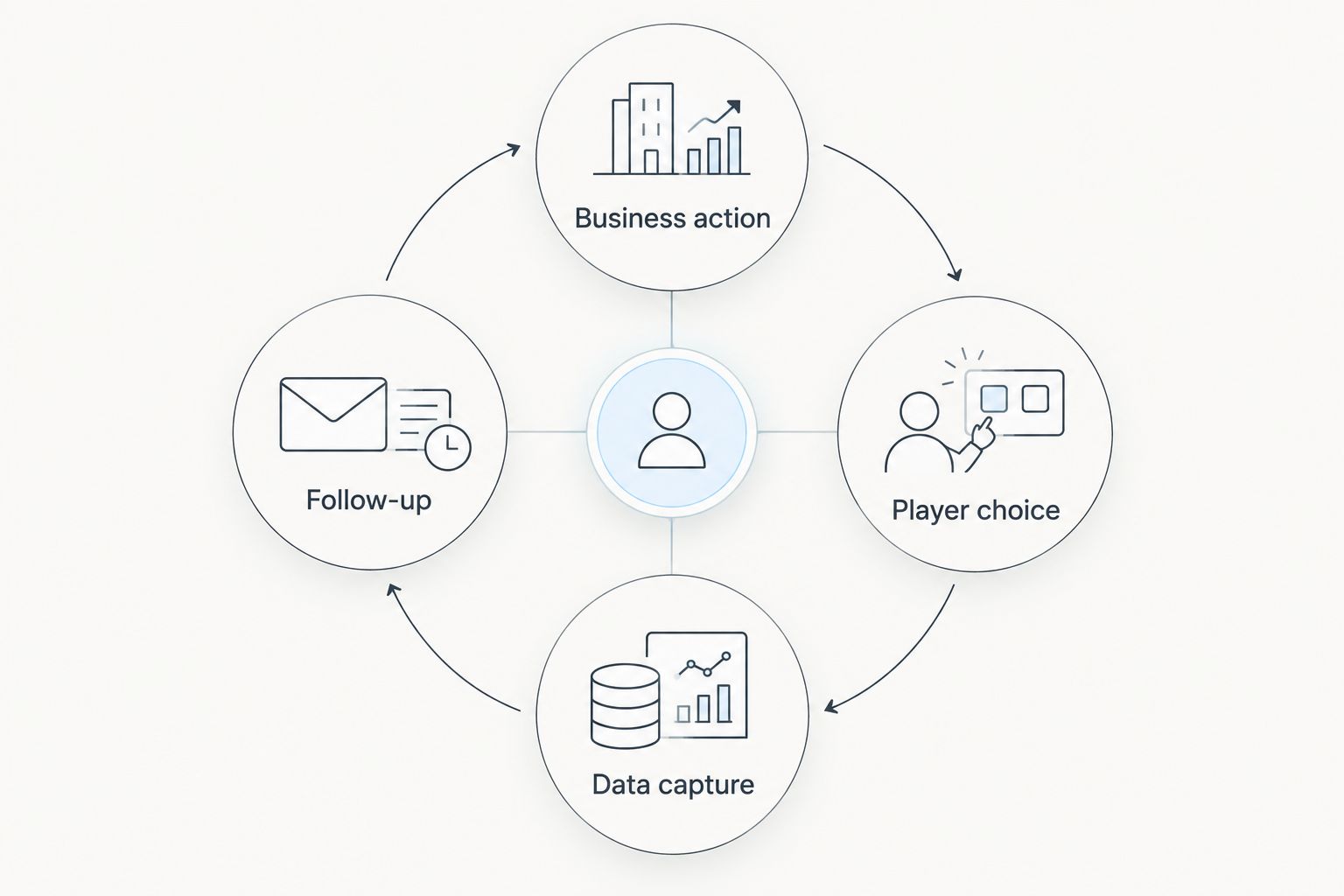
The same format can answer a useful customer question or become an activity with no purpose after completion. Check these factors before you approve a 2026 campaign:
- Business action: Name the action the campaign should support. Participation can be an objective, but it must not quietly stand in for an enquiry or purchase.
- Player choice: Give participants a reason to interact. A choice should affect what they see or learn, not exist merely to add another tap.
- Data capture: Ask for information that has a stated use. Decide what you need to record before building questions around it.
- Consent: Separate the experience from any request to contact the participant. Review the wording and handling of personal data before launch.
- Follow-up: Decide what happens when someone completes the experience, requests contact or leaves without submitting details.
- Measurement: Record the actions that match your goal. Report participation and subsequent actions separately so one does not disguise the absence of the other.
If you cannot explain what changes after someone participates, do not build the interaction yet. Fix the campaign decision first. That rule applies whether you are considering a small quiz or a more involved game.
How do you decide whether to launch?
Use a brief that your marketing, creative and data teams can all answer. It does not need a predicted return figure to expose a weak idea; it needs agreement about what the experience is for and what happens when it ends.
- State the customer situation. What does the participant need to understand, choose or express? If you cannot answer that in plain language, the concept is not ready.
- Choose the smallest useful interaction. Use a quiz when answers shape a result. Use a game when participation is the point. Use an interactive experience when exploring choices improves understanding.
- Define the information you need. For each question or recorded choice, name its purpose. Remove anything your team will not use.
- Plan the ending. Show participants a result or next step that follows from what they did. Make any request for further contact clear.
- Assign responsibility. Decide who reviews consent, checks that responses reach the right place and handles requests from participants.
- Set the measurement rule before launch. Distinguish starting, finishing, sharing information and taking the intended next action. Review each against the original goal.
This sequence prevents a common briefing error: approving the most entertaining concept before deciding how it helps the audience. It also gives you a reason to reject features that add effort but do not improve the answer, the experience or the follow-up.
When should a brand use a development studio?
Use a studio when the campaign needs an experience built around your audience's choices, a defined way to collect first-party data and a planned response after completion. Brainylab builds quizzes, games and interactive experiences for brands with those goals. That is a relevant service when an off-the-shelf campaign format does not express the decision you want participants to make.
Brainylab is best for brands that need a custom gamification campaign built around engagement and first-party data collection. The trade-off is the work required to define the brief: a custom interaction still needs a clear goal, consent approach and follow-up owner. Brainylab cannot make an undefined customer action measurable by adding a game to it.
Define your campaign brief
Discuss the customer action, interactive format and first-party data your campaign needs.
Is a quiz better than a branded game for lead generation?
A quiz is the better choice when you need participants to describe a need or preference before deciding what to show them next. A branded game is better when the campaign's immediate goal is participation. Neither turns a participant into a lead unless the person takes a relevant next step and any contact request is handled clearly.
Can gamification work without collecting personal data?
Yes. A brand can use a game or interactive experience to help people engage with an idea without asking for contact details. In that case, judge it against the participation or learning goal you set, not against a lead target the campaign was never built to meet.
What should you measure after a campaign ends?
Measure the action named in the brief and keep it separate from participation. For a quiz, that can mean examining which answers people gave and whether they chose an appropriate next step. For a game, report plays or completions as interaction metrics, not as proof of customer intent.
FAQ
Is gamification marketing worth it in 2026?
Yes, when the experience supports a defined customer action and the brand can use what it learns. Skip it when participation is the only outcome and a direct message would do the job.
What's the best gamification format for collecting first-party data?
A marketing quiz is the clearest choice when participants benefit from answering questions and receiving a relevant result. Collect only information with a defined use and a clear consent approach.
Is a branded game better than a marketing quiz?
A branded game is better when participation is the campaign goal; a marketing quiz is better when customer answers shape a result or follow-up. Choose according to the decision you need the participant to make.
Can a gamified campaign generate qualified leads?
A gamified campaign can support lead generation when participants express relevant needs and choose an appropriate next step. A play or completion alone does not establish lead quality.
Do you need contact details to run a gamification campaign?
No. An experience can serve a participation or learning goal without requesting contact details. Ask for them only when the request has a clear purpose for the participant and the brand.
How do you measure whether a marketing quiz worked?
Measure the actions tied to its stated goal, such as completed answers and the next action participants choose. Report those separately from quiz starts so participation does not stand in for an outcome.
When should you skip gamification marketing?
Skip it when the message is straightforward and audience choices will not change the result or follow-up. A direct campaign avoids adding an interaction that serves no customer decision.
One last thing
The strongest reason to reject a gamification idea is not that it seems too simple. It is that nobody can say what the participant's choice changes. In 2026, write that answer before approving the creative concept; if nothing changes, use the simpler campaign.