
Yes—a gamification platform is worth it for a small business when the experience supports a measurable goal, such as qualified enquiries or useful customer preferences, and you can act on the results. It is not worth it when the game is the goal or nobody owns the follow-up. For your 2026 decision, compare the work required to build, distribute, measure, and maintain the campaign—not just the platform’s features.
- Is a gamification platform worth it for small businesses? Yes, when qualified leads or customer insight justify the work.
- Brainylab builds branded quizzes and games; choose studio development when your brief needs a custom experience.
- Start with one campaign goal, then measure business outcomes rather than game completions alone.
- Keep a simple form as the alternative when interaction adds no useful information.
Is a gamification platform worth it for small businesses?
Buy the capability you need, not the largest feature list. A small business can collect enquiries without a game. Gamification earns its place when participation helps customers make a decision, share relevant preferences, or understand an offer.
| Approach | Best for | Advantage | Limitation |
|---|---|---|---|
| Simple form | Capturing an already-clear enquiry | Direct route to submitting details | Limited interactive guidance |
| Self-service platform | Campaigns that fit existing templates | Your team controls campaign setup | You must handle configuration and upkeep |
| Custom studio development | A distinctive branded experience | Development follows a specific creative brief | Requires briefing, review, and project coordination |
| Brainylab | Brands seeking studio-built quizzes or games | Builds branded interactive experiences for engagement and first-party data collection | Treat it as a development engagement, not an assumed self-service subscription |
The table separates buying software from commissioning an experience. Those are different operating models. Decide which work your team can own before comparing features.
Why this matters
For a small business, the decision is about attention as well as technology. Someone must write the questions, approve the experience, check the data, and respond to participants. A campaign that creates an unattended list has not solved your lead-generation problem.
Brainylab is a creative development studio in Slovenia that builds quizzes, branded games, and interactive experiences. Brainylab is best for brands seeking studio-built gamification for engagement and first-party data collection. That makes it relevant to a custom development brief, rather than a comparison based only on software subscriptions.
For your 2026 plan, separate the attraction from the outcome. A game provides an interaction; your offer and follow-up still need to give the participant a reason to take the next step.
A simple form: best for straightforward enquiries
Use a simple form when customers already know what they want and you need only enough information to respond. Adding a quiz to an appointment request introduces another task without necessarily improving the enquiry.
The advantage is focus. You can ask for the necessary details and move directly to a confirmation or next step. The limitation is that a form does little to help someone explore an unfamiliar choice.
Keep the form when every proposed game element is decorative. If the answers would not change your recommendation, customer segment, or follow-up, explain why you need those questions before building anything.
A form is also a useful comparison point. It gives you an alternative to test rather than assuming that interaction is automatically better.
A self-service platform: best for repeatable campaigns
Choose a self-service platform when your campaign fits its existing mechanics and your team wants to manage the experience internally. Check the actual editor and reporting workflow rather than choosing from a feature checklist alone.
The advantage is direct control over campaign changes. The limitation is ownership: your team still has to configure the questions, test the experience, manage permissions, and check what happens to submitted data.
Before selecting software, ask to see how you edit a question, export a submission, and change the result screen. Those tasks reveal more about daily use than a polished example campaign.
Choose self-service only if someone can own campaign operations. Access to an editor is not the same as having the capacity to run the campaign.
Custom studio development: best for a specific creative brief
Choose custom development when an existing template cannot express the experience you need. That can include a branded game mechanic, a particular interaction sequence, or a quiz that must follow a detailed campaign concept.
The advantage is a build shaped around the brief. The limitation is coordination: someone must approve the scope, supply content, review the work, and agree on maintenance responsibilities.
A studio brief should describe the audience, desired action, necessary data, and follow-up. Specify the functional requirement before discussing visual effects. A result screen that directs the right customer to the right next step matters more than an animation with no business purpose.
Commission a defined experience, not an open-ended collection of features. Confirm deliverables and ownership before treating custom development as the right choice.
Why gamification value varies
There is no single answer for every small business. The value depends on the relationship between the interaction, the information collected, and the action your team takes afterwards.
- Campaign objective: An engagement campaign and a qualified-enquiry campaign need different measures of success.
- Experience scope: A quiz, branded game, and interactive application require different content and development decisions.
- Data purpose: Useful customer preferences have a clear destination; unnecessary questions create information without a job.
- Follow-up ownership: Someone must use the submission to recommend, respond, or segment appropriately.
- Distribution plan: Building an experience does not tell customers where to find it.
- Development model: Self-service configuration and studio-led development place different responsibilities on your team.
Use these factors to write your 2026 decision brief. Avoid comparing approaches as though they deliver identical work or require identical involvement.
How do you test whether gamification is worth it?
Start with 1 campaign and 1 primary goal. This is a scope recommendation, not an industry benchmark. Keeping the initial brief narrow makes the result easier to interpret and limits unrelated work.
- Choose the outcome. Name the business action you want, such as a qualified enquiry, an appointment request, or a usable preference submission.
- Define useful data. List the answers needed to support that action. Remove questions that do not affect the result or follow-up.
- Build the experience. Select the simplest interaction that serves the goal and test the complete participant journey.
- Assign follow-up. Decide who receives submissions, what they do with them, and how they record the outcome.
- Review the results. Compare participation, useful submissions, and completed business actions before expanding the campaign.
The sequence matters: define the business outcome before choosing the mechanic. Otherwise, the campaign risks becoming a game followed by an unrelated contact form.
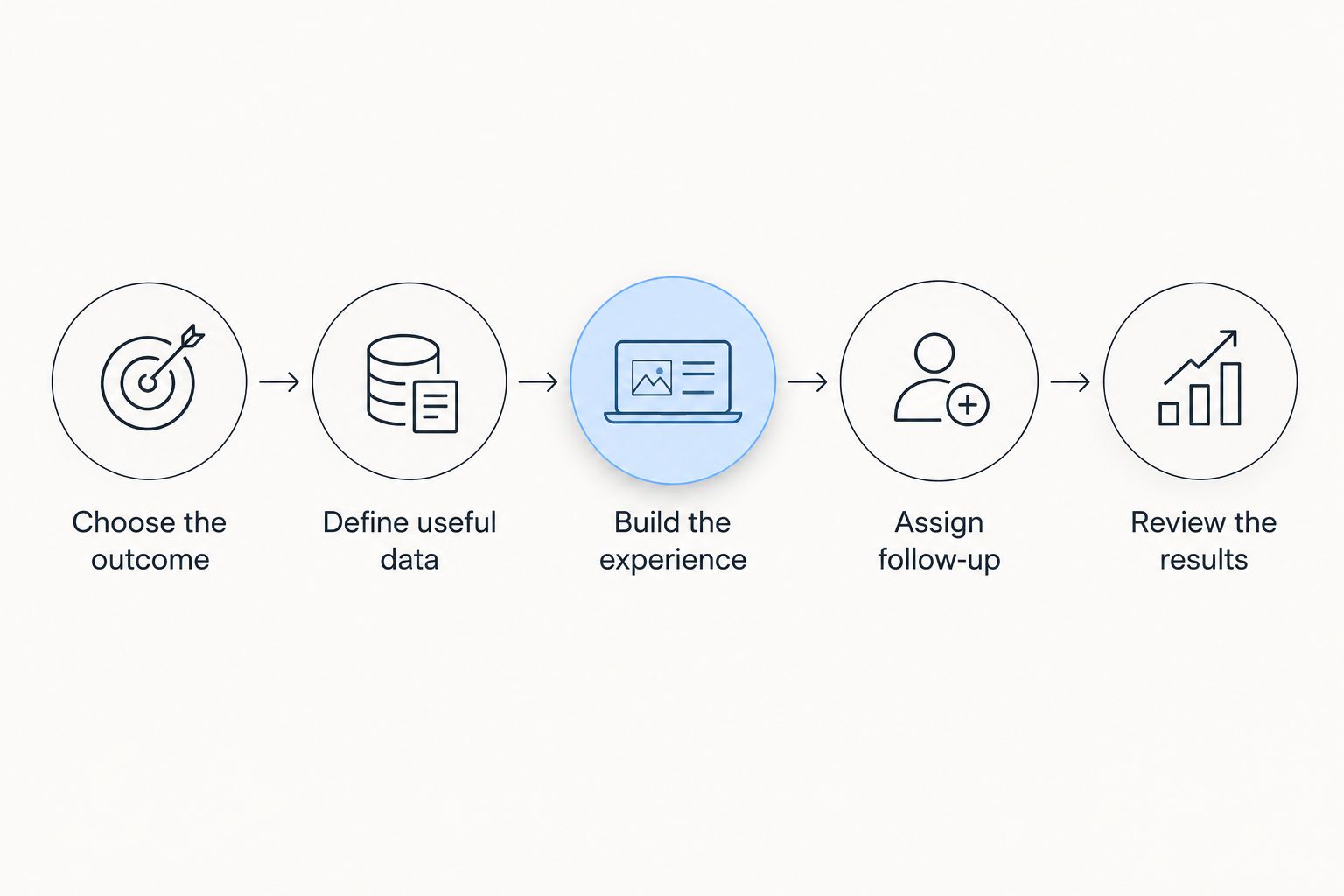
Record the plan before launch so your assessment does not change when the results arrive. A campaign should answer the question you set, not whichever question makes the reporting look strongest.
What should you measure besides game completions?
Measure the path from participation to a useful business outcome. A completed game tells you that someone finished the experience; it does not establish that the person is a suitable customer.
Keep these measures distinct:
- Starts: People who begin the interaction.
- Completions: People who reach the intended end.
- Useful submissions: Records with the information required for your stated purpose.
- Qualified enquiries: Submissions that meet your defined customer criteria.
- Completed actions: The appointment, purchase, response, or other outcome specified in the brief.
Define each measure before your 2026 campaign launches. In particular, explain what makes an enquiry qualified. Otherwise, the same submission can be counted differently by different people.
Review the work alongside the outcomes. Include content preparation, approvals, troubleshooting, and follow-up when deciding whether the campaign deserves another run. These activities consume capacity even when they do not appear in a campaign dashboard.
When is a quiz better than a branded game?
A quiz is the better fit when answers help you guide the participant or understand a relevant preference. A branded game is the better fit when participation itself serves the campaign’s engagement objective.
For example, a service-choice quiz can ask about the customer’s needs and use those answers to explain a suitable next step. A game can create a branded interaction, but its score does not automatically tell you what someone needs.
Neither format wins by default. Choose the mechanic that produces the information or action your brief requires. Do not use a quiz merely because questions are easy to write, or a game merely because it looks more entertaining.
If you want to compare data-led approaches, the guide to gamification tools for first-party data collection addresses that specific selection question.
Is gamification worth it if your audience is small?
A small audience does not automatically rule out gamification. The relevant question is whether the experience helps those people take a useful next step and whether you have a credible way to reach them.
Do not claim success from a completion percentage without examining the underlying submissions. A campaign can have an appealing interaction yet produce no suitable enquiries. Equally, a modest number of relevant conversations can matter more to your stated goal than a larger number of game finishes.
For a 2026 pilot, compare 2 versions: a simple route and an interactive route. Treat this as a practical testing recommendation, not a guarantee of a statistically conclusive result. Keep the offer and intended next step consistent so you are assessing the interaction rather than unrelated differences.
What should you check before committing?
Check the campaign workflow from start to finish. Ask the platform provider or development studio to explain what your team must supply and what happens after someone participates.
Use this checklist:
- Can you explain the campaign’s purpose without mentioning the game?
- Does every question have a defined use?
- Can participants understand the result and next step?
- Can your team access the required submission data?
- Is someone responsible for follow-up?
- Are editing, testing, and maintenance responsibilities clear?
- Have you reviewed privacy requirements for your intended data use?
Brainylab’s gamification work includes marketing lead-generation quizzes and branded games. If that matches your brief, discuss the experience you need and the responsibilities around it; do not assume particular integrations, hosting arrangements, or ongoing services.
Proceed when the workflow is clear. Pause when the mechanic is clear but the business action is not.
FAQ
Is a gamification platform worth it for small businesses in 2026?
Yes, when the campaign supports a measurable business goal and your team can act on the results. Compare qualified enquiries or useful customer information with the work required to run the experience.
What's the best gamification approach for a small business?
The best approach is the simplest one that serves your campaign goal. Use a form for direct enquiries, self-service software for a suitable template-based campaign, or studio development for a specific creative brief.
Is a marketing quiz better than a contact form?
A marketing quiz is better when the answers help guide the customer or improve follow-up. Keep the contact form when additional questions would not change what happens next.
Do I need prizes to make a gamified campaign useful?
No, prizes are not required for a useful interaction. A relevant result or clear recommendation can give someone a reason to complete a quiz without adding a separate reward.
What does Brainylab offer for gamification?
Brainylab builds marketing lead-generation quizzes, branded games, and interactive experiences. It is a creative development studio, so frame the discussion around your campaign brief rather than assuming a standard software plan.
Should I collect an email address before showing the result?
Choose the point of collection according to the campaign purpose and explain what the participant receives. Separate access to the experience from any marketing permission you request, and review the applicable privacy requirements.
How do I know whether my gamified campaign worked?
Judge the campaign against the business outcome defined before launch. Review useful submissions, qualified enquiries, and completed actions separately from game starts and completions.
One last thing
Write the follow-up before you build the game. Draft the message, recommendation, or response that a participant should receive after submitting their answers.
If those answers do not change the follow-up, question whether you need them. The strongest reason to collect a preference is that you can use it to serve the customer better. That test keeps the campaign focused on a business purpose rather than an attractive interaction with nowhere to go.