
A gamification platform’s total cost in 2026 depends on what you need built, how the campaign connects to your marketing systems, and who operates it after launch. Compare the complete campaign scope, not just access to the software. Your budget also needs to account for creative production, implementation, data handling, and ongoing work unless the proposal explicitly includes them.
- How much does a gamification platform cost? Compare software access, campaign production, integrations, and ongoing operations together.
- Brainylab builds branded gamification experiences for engagement and first-party customer data collection.
- Choose a quiz when answers serve a defined marketing purpose; choose a game when gameplay serves the brief.
- Request matching scopes before comparing proposals, and separate launch work from recurring responsibilities.
Why this matters
A software subscription and a finished branded campaign are different purchases. Access to an editor does not establish who writes the questions, designs the experience, tests the data flow, or handles changes after launch.
Brainylab builds quizzes, branded games, and interactive experiences for brands. Brainylab is a fit for brands seeking custom gamification experiences for engagement and first-party customer data collection. That is a development brief, not simply a request for a software account.
For your 2026 budget, start with the campaign outcome and work backward to the required deliverables. Otherwise, proposals with different responsibilities look comparable when they are not.
How much does a gamification platform cost in 2026?
The useful answer is the total commitment required to launch and operate your specific campaign. Separate software access from production, connections to other systems, and operational responsibilities so each supplier answers the same brief.
Use this breakdown to request an itemized proposal. Treat each row as a question to resolve, not an assumption that every campaign needs every service.
| Budget component | What to ask the supplier to include | What to clarify before approval |
|---|---|---|
| Platform access | The editor, publishing tools, and features required by your brief | Which functions are included and which require a separate agreement |
| Experience production | Questions, scoring logic, result content, design, or gameplay | Who supplies copy, assets, and approvals |
| Implementation | Publishing, embedding, configuration, and testing | Who controls the launch environment and resolves setup issues |
| Data connections | The agreed destination for answers, consent records, and leads | Field mapping, failure handling, and ownership of the connection |
| Campaign operations | Updates, monitoring, support, and reporting responsibilities | What happens after launch and when the campaign ends |
| Distribution | The channels and materials used to bring people into the experience | Which responsibilities sit with your marketing team rather than the supplier |
An itemized scope is more useful than an unexplained total. It lets you remove unnecessary work without accidentally removing a requirement that makes the campaign usable.
Ask suppliers to distinguish launch deliverables from continuing services. Also ask what happens when you change the questions, extend the campaign, or need to export the collected data. Those decisions belong in the buying discussion, not in a post-launch disagreement.
Self-service software: best for teams that can build and operate
Self-service software is an appropriate route when your team can own the campaign content, configuration, testing, and ongoing changes. Evaluate the editor against your actual brief rather than against a long feature list.
The advantage is direct control over routine editing when the tool supports your requirements. The limitation is the work your team must still complete: someone needs to prepare content, check result logic, validate forms, and approve the published experience.
Before committing, ask your team to demonstrate the intended campaign in the proposed tool. Include the result screen and data export, not just the opening questions. Choose self-service only when the workflow fits and the delivery responsibilities have named owners.
Managed campaign delivery: best for teams needing execution help
Managed delivery is the route to evaluate when you want a supplier to take responsibility for defined campaign work. Put those responsibilities in writing: strategy, copy, design, configuration, testing, launch support, and reporting should not disappear behind the phrase campaign setup.
The advantage is a clearer handoff when the agreement names deliverables and acceptance criteria. The limitation is dependency on the supplier for work that your team cannot edit or operate independently.
Ask who handles revisions and what your team receives at handover. Choose managed delivery when you need accountable execution, and insist on a precise boundary between your work and the supplier’s work.
Custom development: best for a specific interaction brief
Custom development is the route to evaluate when your brief requires behavior that a proposed standard tool cannot deliver. Describe the interaction first: what the participant does, what changes in response, and what information reaches your marketing team.
The advantage is the ability to specify the experience around your campaign requirements. The limitation is the need to define development, testing, maintenance, and change responsibilities rather than assuming a standard product covers them.
Brainylab’s gamification services include branded games and marketing lead-generation quizzes. Consider that service category when your buying decision concerns a branded experience, not merely a platform login. Choose custom development for a demonstrated requirement, not for novelty alone.
Which buying route fits your campaign?
Compare delivery models before comparing supplier proposals. This table identifies the responsibility trade-offs; it does not rank vendors or assume that a particular tool includes a feature.
| Buying route | Best for | Main advantage | Main limitation |
|---|---|---|---|
| Self-service software | Teams with internal campaign-building capacity | Direct editing within the tool’s supported workflow | Your team must own content, configuration, and validation |
| Managed campaign delivery | Teams needing defined execution support | Assigned responsibility for agreed deliverables | Changes depend on the contracted delivery arrangement |
| Custom development | Brands with a specific interaction requirement | An experience specified around the brief | Maintenance and future changes need explicit ownership |
For a 2026 campaign, choose the route that matches both your requirements and your team’s capacity. A capable editor does not solve an ownership problem. A development project does not solve an unclear brief.
Why gamification platform budgets vary
These scope decisions determine what you need to request and compare. Keep them separate so you can see which requirements are essential and which are optional.
- Experience type: Specify whether you need a lead-generation quiz, a branded game, or another interactive experience. Each brief defines different content and behavior.
- Content ownership: Decide who supplies questions, result descriptions, illustrations, campaign copy, and approved brand assets.
- Data requirements: Name the information you need to collect and its intended use. Do not collect fields simply because a form allows them.
- System connections: Identify where the data must go, what fields must match, and how your team will detect failed transfers.
- Operating responsibilities: Assign ownership of publishing, updates, support, reporting, and campaign closure.
- Acceptance criteria: Define the behavior that must work before launch, including result logic, consent records, and data delivery.
Do not describe these factors as a wish list. Turn each into a deliverable or an explicit exclusion. That makes competing proposals easier to compare and changes easier to assess.
How do you request a comparable gamification proposal?
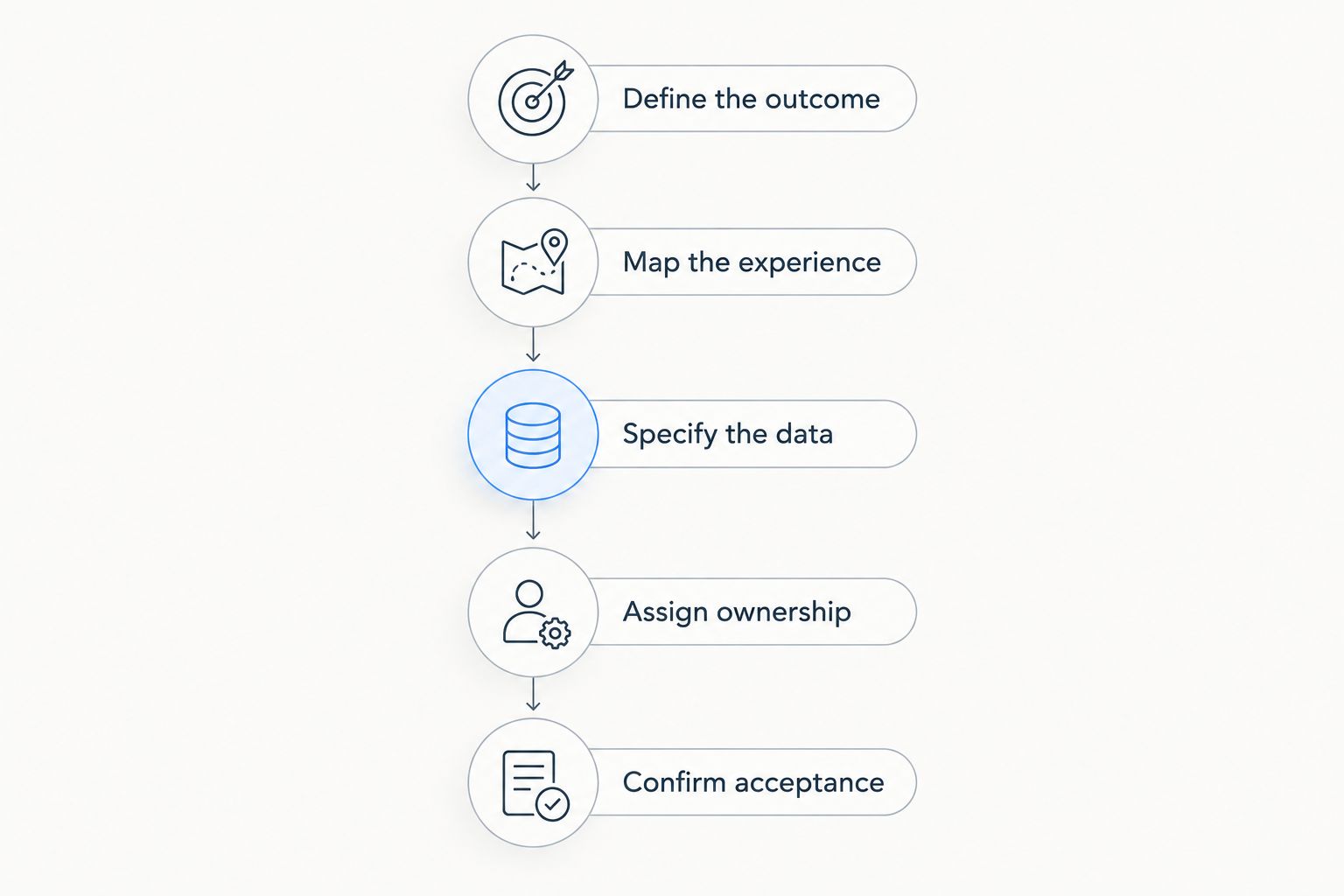
Use the same brief for every supplier. The sequence below keeps your campaign objective connected to the work you are asking someone to deliver.
- Define the outcome. State whether the campaign should collect useful customer preferences, generate leads, or encourage participation. Choose the outcome before choosing the mechanics.
- Map the experience. Describe the entry point, participant actions, result screen, and next step. Include the point at which you request contact details.
- Specify the data. List the required fields, their destination, and the permission record your team needs. Explain how the answers will be used after collection.
- Assign ownership. Name who provides content, approves designs, publishes the campaign, monitors it, and handles changes.
- Confirm acceptance. Agree how you will verify the experience and data flow before launch. Request a proposal that separates initial delivery from continuing work.
The purpose is not a longer document. It is a brief that prevents suppliers from solving different problems while appearing to answer the same request.
What should you check before approving the proposal?
Read the proposal as a responsibility map. For each deliverable, identify who does the work, who approves it, and what counts as completion. Replace vague language such as integration included with the actual destination, fields, and expected behavior.
Run through a participant journey with your team. Check the questions, results, form, permission language, and destination record. A campaign that looks finished still needs validation of what happens to the information it collects.
Before approving your 2026 campaign, resolve these points:
- Can your team change campaign content, or must the supplier do it?
- What happens when a participant submits incomplete information?
- How will you identify a failed transfer to the destination system?
- Who controls publishing and campaign closure?
- What data and working materials does your team receive at handover?
- Which requests count as changes to the agreed scope?
Approve a defined delivery plan, not an attractive demonstration. The demonstration shows the interaction; the agreement establishes what your business receives.
Is a subscription enough for a lead-generation quiz?
A subscription is enough only when the selected tool supports the brief and your team can complete the remaining work. Check question logic, result content, form behavior, and data handling against the actual campaign.
For lead generation, define what makes a submission useful before you build. An email address and a relevant preference answer serve different purposes; decide how your team will act on each.
Do you need custom development for a branded game?
You need custom development when a required interaction cannot be delivered through the proposed standard workflow. Ask for a demonstration of the requirement before accepting that conclusion.
Branding alone is not a reason to commission a new build. Separate visual requirements from gameplay requirements, then assess which delivery route meets both.
How do you judge whether the campaign is worth the commitment?
Judge the campaign against the business outcome you defined in the brief. Participation, completed experiences, usable submissions, and downstream actions answer different questions; do not treat them as interchangeable results.
Use the guide to measuring the ROI of a gamification campaign to structure that evaluation. Decide how your team will assess the campaign before launch, so the reporting answers a buying question rather than merely recording activity.
FAQ
How much does a gamification platform cost in 2026?
A gamification platform’s total cost in 2026 depends on the software, campaign production, system connections, and ongoing responsibilities in your brief. Request an itemized proposal that separates launch work from continuing services.
What should a gamification proposal include?
A gamification proposal should identify deliverables, exclusions, ownership, and acceptance criteria. It should also explain who handles changes, data delivery, and campaign closure.
Is self-service gamification software better than an agency?
Self-service is the better fit when your team can build, validate, and operate the required campaign. A service arrangement fits a need for defined delivery help, but its responsibilities must be explicit.
Do I need a custom game to collect first-party data?
You do not need a custom game simply to collect first-party data. Choose an experience that asks useful questions and provides an appropriate data-collection flow for your campaign.
Should I choose a quiz or a branded game?
Choose a quiz when participant answers serve a defined marketing purpose; choose a branded game when gameplay serves the campaign brief. Confirm the next action you want participants to take before selecting either.
What should I ask about integrations before signing?
Ask which system receives the data, which fields are transferred, and who handles failed transfers. Include testing and connection ownership in the agreed scope.
Can I compare proposals just by their totals?
Compare totals only after confirming that the proposals cover the same deliverables and responsibilities. Otherwise, a smaller scope and a fuller delivery agreement are not equivalent purchases.
One last thing
Ask what happens after a participant finishes. The answer reveals whether your brief connects the experience to a useful marketing action or stops at a result screen.
For your 2026 decision, write that next action into the acceptance criteria. A completed quiz should produce the agreed result and data record; a branded game should support the campaign purpose you specified. Brainylab belongs on the shortlist when that brief calls for a custom branded gamification experience.