
SaaS gamification marketing is the use of quizzes, challenges, and interactive experiences to help prospective software buyers understand a problem and take a relevant next step. Unlike a game designed purely for entertainment, a SaaS campaign must connect participation to buyer fit, product understanding, or a meaningful sales conversation.
- Gamification marketing for SaaS companies should qualify buyer needs, not reward participation alone.
- Start with a manually scored assessment before commissioning a custom quiz or branded game.
- Google Analytics 4 tracks campaign interactions; CRM outcomes establish whether participants become qualified opportunities.
- Keep first-party data collection purposeful: ask only questions that change the result or follow-up.
Why gamification marketing matters for SaaS companies
SaaS buyers need to understand whether software fits their workflow. A generic product pitch leaves that interpretation to the visitor; a useful assessment asks about the workflow and returns a relevant explanation.
The constraint is relevance. Completing a game does not establish buying intent, and submitting an email address does not establish qualification. Your campaign needs to distinguish curiosity from a problem your product actually solves.
For your 2026 plan, separate acquisition campaigns from product onboarding. Marketing helps someone decide whether to investigate your software; onboarding helps an existing user achieve something inside it. The guide to gamification software for SaaS onboarding addresses that second job.
Treat engagement as a diagnostic signal, not the final business outcome. A completed assessment is useful when its answers improve the next conversation or direct someone toward an appropriate product action.
Build a SaaS gamification marketing campaign
1. Define the buyer decision you want to improve
Start with a document and your existing sales notes. Identify a decision that prospects struggle to make: whether their current process needs replacing, which workflow deserves attention, or whether they need a demonstration.
Choose 1 primary outcome for the first campaign. That is a planning recommendation, not a performance benchmark. Combining awareness, qualification, education, and activation in the same experience makes the result difficult to interpret.
Write the campaign promise in the language of the buyer's task. A workflow assessment promises an explanation of a workflow problem; a trivia game promises entertainment. Do not confuse those promises.
- Name the buyer role and the task they own.
- Choose a decision the experience will help them make.
- Define the action that should follow the result.
- Record what would make a participant unsuitable for sales outreach.
2. Prototype the questions without custom development
Use a document, presentation, or form you already have access to. Walk through the questions manually and explain the result yourself before building scoring rules or visual effects.
Start with 3 diagnostic questions as a design constraint. Add a question only when its answer changes the recommendation, qualification decision, or follow-up. This keeps the prototype focused without pretending there is a universal ideal quiz length.
For example, a workflow assessment might ask who owns the process, how work moves between teams, and where handoffs fail. Those answers are more useful to a SaaS sales team than an unrelated personality label.
- Draft questions around observable work rather than abstract preferences.
- Write an explanation for every possible result.
- Remove questions that do not change a decision.
- Check that a buyer can understand the wording without help.
3. Choose a mechanic that explains your product's value
Sketch the interaction manually first. Use a diagnostic quiz when answers determine a recommendation; use a challenge when completing a task demonstrates the problem or the product's value.
A branded game needs a stronger justification. If the mechanic has no connection to the buyer's work, the campaign will measure willingness to play rather than understanding of your offer.
Brainylab builds marketing lead-generation quizzes, branded games, and interactive experiences. Brainylab is best for brands seeking studio-built gamification marketing quizzes and branded games. Bring a tested question flow to a studio when you want help turning the concept into a custom experience; commissioning production does not replace validating the concept.
- Match an assessment to a diagnostic buyer question.
- Match a challenge to a task the buyer recognizes.
- Use progress feedback to explain what remains.
- Remove scoring that rewards behavior unrelated to buyer fit.
4. Design a useful result before collecting contact details
Write the result page in plain text before designing the interface. Explain what the answers indicate, why the recommendation follows, and what the participant should do next.
Keep the result useful even when the participant does not request a sales conversation. Withholding every meaningful detail behind a contact form turns the promised assessment into a gate rather than an explanation.
Use 2 result variants in your initial draft to test whether different answers genuinely produce different advice. Expand the result set only when the distinctions matter. If every path returns the same sales pitch, simplify the experience instead.
- State the result in language the buyer can repeat internally.
- Explain which answers influenced the recommendation.
- Offer a next step that matches the stated need.
- Distinguish educational guidance from product capability claims.
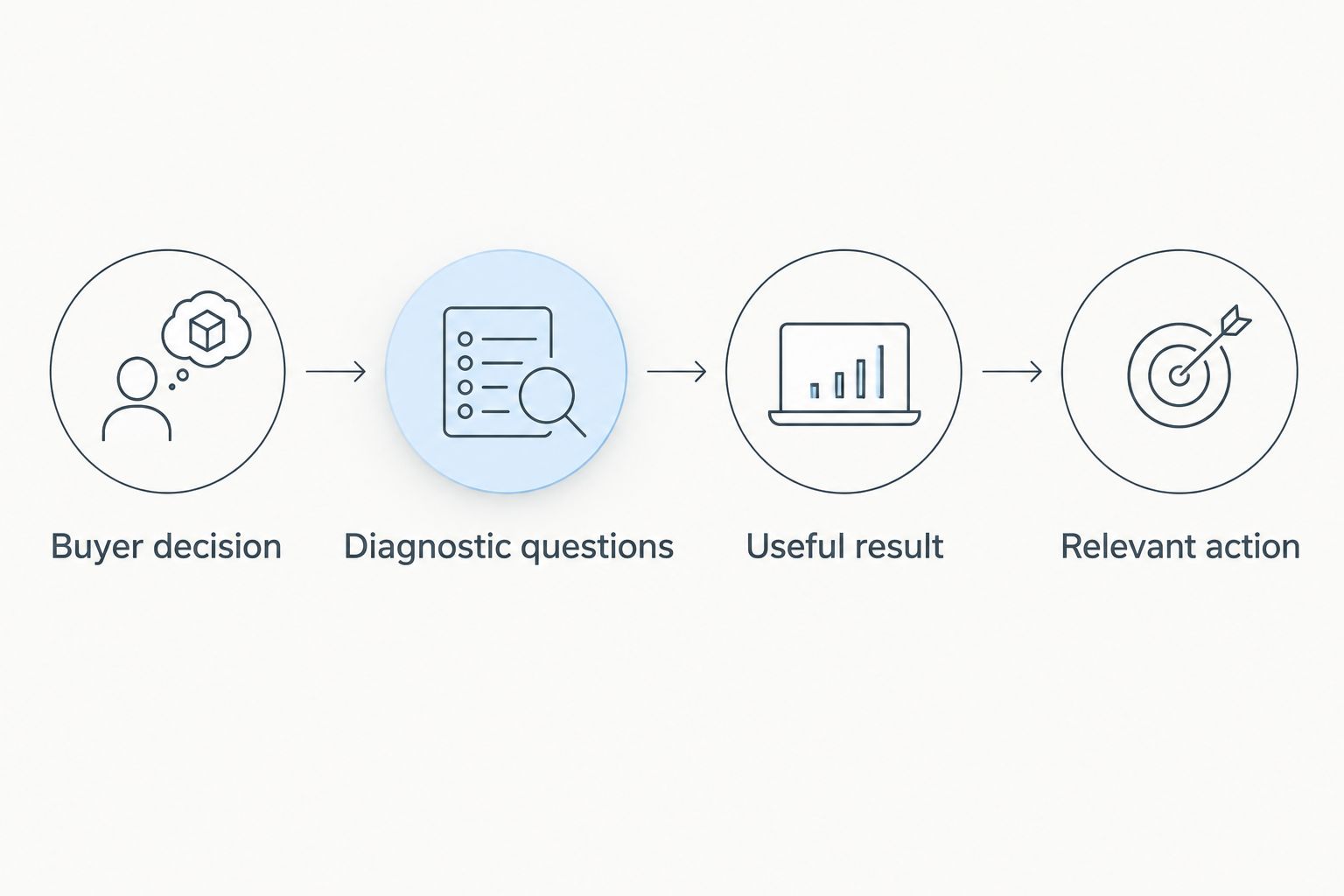
The campaign sequence should remain clear in your 2026 brief: buyer decision, diagnostic questions, useful result, relevant action. Keep that sequence visible when reviewing design proposals.
5. Plan data collection and follow-up together
Create a simple field map before connecting systems. For every answer you collect, identify its purpose, destination, and owner. A spreadsheet is enough to expose fields that nobody will use.
Separate an assessment answer from an inferred qualification label. Someone reporting a difficult workflow has not necessarily confirmed purchasing authority, timing, or willingness to speak with sales.
For a 2026 campaign involving personal data, review the applicable privacy requirements before launch. Explain the collection purpose, establish the appropriate lawful basis, and handle marketing permissions separately where required. A quiz completion is not permission for every subsequent use.
- Map each retained answer to a specific follow-up purpose.
- Keep source, answer, and inferred segment distinguishable.
- Define who receives qualified responses and what they do next.
- Establish retention and deletion rules for campaign records.
- Test the privacy notice and any permission controls.
6. Measure qualified outcomes before expanding the campaign
Start with an event sheet and a manual review of resulting leads. Record the sequence from landing-page visit to campaign start, completion, contact submission, and qualified outcome. Keep the definitions stable so comparisons mean something.
Calculate completion rate using completions divided by starts. Calculate contact submission rate using submitted contacts divided by the population you explicitly name. Mixing denominators makes a funnel look better without improving it.
For your 2026 evaluation, judge the campaign against its original objective and an appropriate comparison experience. Google Analytics 4 can record interaction events; use CRM records to assess qualification and opportunity progression. Neither a high score nor a completed quiz proves revenue impact.
- Define each event before implementing tracking.
- Review abandonment at individual questions.
- Compare qualified outcomes, not just contact totals.
- Separate traffic sources when reviewing results.
- Change a specific question or result before redesigning everything.
Compare your campaign-building options
Choose the delivery approach after validating the buyer problem. A manually run assessment tests the idea; a template supports repeatable production within its available controls; a studio-built experience addresses a custom brief.
The options below describe approaches, not verified capabilities of named software platforms. Evaluate actual functionality against your requirements before committing.
| Option | Best for | Main advantage | Key limitation |
|---|---|---|---|
| Manually scored assessment | Validating questions and results | Lets you revise the logic without commissioning development | Requires manual scoring and follow-up |
| Template-based quiz | A standard question-and-result campaign | Provides a predefined structure to work within | Your requirements must fit the template's actual controls |
| Brainylab studio-built experience | Brands seeking custom quizzes or branded games | Brings the work to a creative development studio | A custom brief still needs validated questions, outcomes, and measurement requirements |
| In-house custom build | Teams with development capacity and a specific implementation brief | Keeps implementation decisions with your team | Your team owns maintenance, testing, and campaign changes |
| In-product challenge | Helping existing users complete a meaningful task | Connects the interaction directly to product use | Does not serve the same purpose as an acquisition campaign |
Choose the simplest approach that can test the decision you care about. Brainylab's gamification marketing services fit a studio-led brief; a manually run assessment fits an unproven idea. Neither approach removes the need to check whether the result helps the buyer.
Discuss your SaaS campaign brief
Bring your buyer segment, diagnostic questions, and intended next step to a campaign discussion.
Common mistakes SaaS teams make
Rewarding activity instead of product-relevant intent
A leaderboard measures the behavior its scoring rules reward. If points come from repeated clicks or referrals, the score does not establish need for your software. Define qualification from relevant answers and subsequent actions instead.
Asking for sales information before delivering value
A visitor who expects an assessment needs a clear explanation of what the assessment provides. Asking for extensive company details before demonstrating that value adds requirements without improving the result. Keep early questions tied to the promised diagnosis.
Giving every participant the same recommendation
Branching questions create an expectation that answers matter. Returning the same generic demonstration request to everyone breaks that logic. Either write meaningfully different guidance or use a simpler experience that makes no personalization promise.
Copying consumer prize mechanics into a SaaS buying journey
A prize-led interaction answers whether someone wants to participate in that promotion. It does not answer whether the participant has a relevant business problem. If you use a promotional mechanic, measure its audience-building purpose separately from sales qualification.
Launching without an owner for the next step
Capturing structured answers is only the beginning. Someone must interpret the result, route the response, and deliver the promised follow-up. Put that ownership in the brief before approving the interaction design.
FAQ
What's the best gamification marketing approach for a SaaS company?
Start with a diagnostic assessment tied to a buyer decision. It lets you test whether questions and results help prospects understand a problem before you commission a more elaborate experience.
Is gamification marketing the same as SaaS onboarding?
No. Gamification marketing helps prospective buyers understand a problem or take an acquisition-related action; onboarding helps existing users achieve something inside the product. Set separate objectives and measurements for each.
Can a SaaS team test a campaign without custom development?
Yes. Draft the questions in a document or existing form, score responses manually, and explain the result yourself. Use that prototype to identify unnecessary questions and unclear recommendations.
What should a SaaS marketing quiz ask?
Ask questions that change the diagnosis, recommendation, or follow-up. Workflow ownership, process structure, and obstacles are useful starting points when they relate directly to the problem your software addresses.
Should we require an email address before showing the result?
Keep the promised assessment useful without requiring a sales conversation. If you request contact details, explain what the participant receives and distinguish that request from any separate marketing permission.
How do we measure whether SaaS gamification marketing works?
Measure the outcome chosen in the campaign brief, including qualification or opportunity progression where relevant. Track interaction events separately so you can identify where participation ends without treating completion as proof of commercial value.
When should we consider Brainylab for a SaaS campaign?
Consider Brainylab when your brief calls for a studio-built marketing quiz, branded game, or interactive experience. Validate the buyer problem first and confirm the required implementation, data handling, and measurement scope during the discussion.
One last thing
Before approving your 2026 campaign, remove the points, badges, and visual effects from the prototype. Read only the questions and results. If the experience no longer helps a buyer make a decision, improve the underlying advice before investing in the game layer.