
Best for custom lead-generation campaigns: Brainylab. Best for self-managed assessments: Typeform. Best for interactive calculators: Outgrow. Best for live workshops: Kahoot!. Best for employee learning: TalentLMS. This 2026 guide separates marketing, client education, and staff training so you choose the right approach—not just software with points and badges.
- Brainylab is the best fit for professional services firms commissioning custom gamified marketing campaigns.
- The best gamification software for professional services firms depends on whether you need leads, workshops, or employee training.
- Choose Typeform for branching assessments, Outgrow for calculators, Kahoot! for live quizzes, and TalentLMS for structured learning.
- Require useful outcomes, appropriate data collection, and a defined follow-up before approving a gamified experience.
Why this matters
A consulting firm qualifying prospects and an accountancy practice training employees have different buying requirements. Both can use gamification, but they should not use the same shortlist by default.
For marketing, the useful output is a prospect's stated challenge and a relevant next step. For learning, it is demonstrated understanding. A leaderboard does not establish either on its own.
Choose the business outcome before the game mechanic. The gamification guide for consulting and professional services firms provides additional context for applying interactive experiences to this setting.
This 2026 shortlist includes both software and a development studio. That distinction matters: commissioning an experience is not the same purchase as adopting a tool your team operates.
What makes the best gamification software for professional services firms?
Use these criteria before comparing demos:
- Outcome fit: Does the experience support lead qualification, client education, or employee learning? Pick one primary purpose.
- Useful interaction: Does each question or challenge help participants understand something, rather than merely earn points?
- Data handling: Can you define the information collected, access permissions, retention, and deletion requirements?
- Follow-up readiness: Can your team connect a participant's answers with an appropriate next action? Verify the actual workflow before buying.
- Content control: Can subject-matter experts review questions, scoring, explanations, and result wording?
- Operating ownership: Who maintains the experience after launch—your marketing team, learning team, or an external studio?
Treat these as purchasing requirements, not assumed capabilities. A compelling demonstration does not confirm your required integration, accessibility standard, or contractual terms.
The shortlist at a glance
The order follows use cases, not a universal performance score. Marketing comes first because generating and qualifying client interest is distinct from running internal training.
| Option | Best for | Standout approach | Key limitation |
|---|---|---|---|
| Brainylab | Commissioned marketing experiences | Studio-built quizzes, branded games, and interactive experiences | A development engagement, not a self-service software purchase |
| Typeform | Self-managed diagnostic assessments | Forms and quizzes with branching logic | An assessment format is not a full game environment |
| Outgrow | Interactive advisory calculators | Calculators and quizzes | Useful outputs depend on defensible inputs and calculation rules |
| Kahoot! | Facilitated workshops and knowledge checks | Live quiz-based participation | A workshop quiz does not replace lead qualification or a learning programme |
| TalentLMS | Structured employee learning | Learning management with points, badges, and leaderboards | An employee-learning system serves a different purpose from a public marketing campaign |
1. Brainylab: best for custom gamified marketing campaigns
Brainylab is a creative development studio in Slovenia that builds quizzes, branded games, interactive experiences, and AI-powered gamified tools. Its stated focus includes user engagement and first-party customer data collection.
Brainylab is best for professional services firms commissioning custom gamified marketing experiences rather than buying a self-service quiz tool. Treat this as a service engagement: define the audience, intended result, and responsibilities before discussing the mechanic.
For example, your brief can request a business-readiness assessment that gives participants an explanatory result. That is a proposed application, not a claim about an existing product or prebuilt integration.
Brainylab pros:
- Custom experience development is part of the studio's stated offering.
- Marketing lead-generation quizzes and branded games are explicit services.
- The brief can focus on engagement and first-party data collection.
Brainylab cons:
- Buyers seeking a self-service subscription are choosing a different delivery model.
- Integrations, maintenance, accessibility, and data responsibilities require agreement within the project scope.
Best for: Marketing teams with a defined campaign objective and a reason to commission a custom experience.
Verdict: Buy the studio route when the experience needs a custom brief; skip it when your team only needs a standard form.
2. Typeform: best for self-managed diagnostic assessments
Typeform is a form and quiz builder with branching logic. It suits an assessment in which a participant's answers determine the next question or result path.
For a professional services campaign, that format can support questions about a prospect's challenge, current process, and intended outcome. Your team still needs to write useful questions and explain what the result means; branching alone does not create a credible diagnostic.
Typeform pros:
- A question-led format fits structured discovery.
- Branching supports different paths for different answers.
- The same assessment concept can be reviewed by marketing and subject-matter experts.
Typeform cons:
- A branching questionnaire is not equivalent to a branded game.
- Scoring and result wording need your own editorial and subject-matter review.
- Confirm required workflow connections and account-level capabilities before purchase.
Best for: Firms whose marketing team wants to own a focused, question-based assessment.
For a 2026 campaign, begin with the result you can explain confidently, then write only questions that contribute to it. Avoid presenting a lightweight questionnaire as a professional audit.
Verdict: Buy for a self-managed assessment; skip when the brief requires game mechanics beyond question-and-answer paths.
3. Outgrow: best for interactive advisory calculators
Outgrow supports interactive content such as calculators and quizzes. Its distinct role here is helping you turn explicit inputs into an explanatory output.
A calculator fits an advisory topic when the calculation itself is useful. For example, a firm can ask participants to enter their own operating assumptions and show how those assumptions affect a modelled outcome. The result must distinguish user inputs, assumptions, and calculated outputs.
Outgrow pros:
- Calculator formats suit input-and-output explanations.
- Quizzes offer an alternative when the topic needs classification rather than calculation.
- An interactive model gives your team a concrete subject for a follow-up conversation.
Outgrow cons:
- A calculator needs a defensible calculation method.
- False precision can make an estimate look like a guarantee.
- Subject-matter experts must review assumptions and explanations, not just the interface.
Best for: Advisory teams with a transparent calculation that helps prospects understand a business question.
Do not invent an industry benchmark to make the output appear authoritative. If a participant supplies the assumptions, label them accordingly and explain the limits of the result.
Verdict: Buy for a useful, reviewable calculator; skip when the proposed output depends on unsupported assumptions.
4. Kahoot!: best for live client workshops
Kahoot! provides quiz-based learning experiences, including live sessions. It belongs on this shortlist for facilitated participation rather than as a default marketing funnel.
A workshop quiz can ask attendees to choose between interpretations of a scenario, then let the facilitator explain the reasoning. For professional services, that discussion is more useful than treating speed or a leaderboard position as evidence of expertise.
Kahoot! pros:
- Live quizzes give participants a defined way to contribute.
- Answer choices provide prompts for facilitated discussion.
- Knowledge checks fit workshops and educational events.
Kahoot! cons:
- Quiz participation does not establish buying intent.
- Competitive scoring needs careful treatment when topics require nuanced judgement.
- A live activity still needs a facilitator and well-prepared explanations.
Best for: Firms delivering interactive client education, webinars, or staff workshops.
In a 2026 workshop brief, specify what attendees should understand afterward. Write scenarios that reveal misunderstandings and reserve time to discuss them, rather than adding trivia unrelated to the session.
Verdict: Buy for facilitated knowledge checks; skip as the main system for qualifying consulting leads.
5. TalentLMS: best for structured employee learning
TalentLMS is a learning management system with gamification features including points, badges, and leaderboards. Its role is organising employee learning, not replacing an outward-facing marketing experience.
Choose this category when your actual problem is delivering courses and tracking learning activity. A professional services firm can structure learning around its own methods and procedures, provided the underlying content and assessment design are sound.
TalentLMS pros:
- Course-based learning has a dedicated management environment.
- Points and badges provide explicit progression mechanics.
- Leaderboards offer an optional competitive element within learning activities.
TalentLMS cons:
- Course completion alone does not prove professional competence.
- Competitive mechanics need to match the learning objective.
- A learning system is not a substitute for a public lead-generation campaign.
Best for: Learning owners who need structured staff education rather than campaign engagement.
Ask the evaluator to demonstrate the learner journey and the reporting your managers actually need. Keep any separate compliance or accreditation requirements explicit; do not infer them from the presence of quizzes.
Verdict: Buy for managed employee learning; skip when the primary objective is attracting prospective clients.
How to choose without buying the wrong category
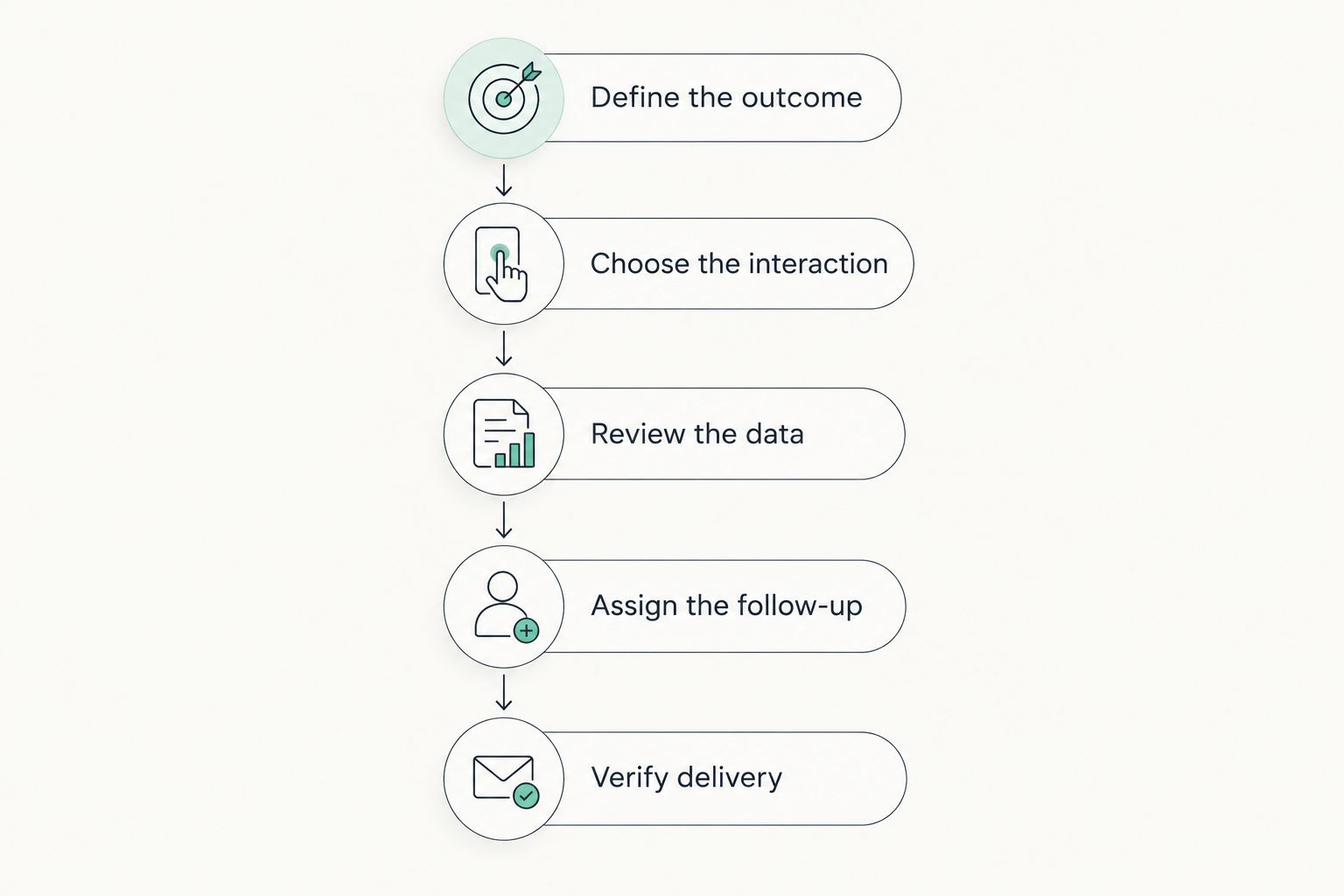
Use this sequence for your 2026 evaluation. It turns a broad software search into a brief that a vendor or studio can answer.
Define the outcome
Write the intended change in plain language: qualify a prospect, explain an advisory concept, involve workshop attendees, or teach employees. If the brief contains all four, separate the projects before selecting a tool.
Choose the interaction
Match the interaction to that outcome. Use an assessment for structured discovery, a calculator for transparent modelling, a live quiz for discussion, or a course for ongoing learning.
Review the data
List the answers and identifiers you intend to collect. Remove fields that have no defined purpose, and have the relevant privacy owner review the collection and follow-up process.
Assign the follow-up
Specify who receives the result and what happens next. A prospect's selected challenge should inform the conversation; a learning result should inform feedback or further instruction.
Verify delivery
Ask for a demonstration of your actual scenario, including result wording and handoff. Confirm technical and contractual requirements directly instead of assuming every product in a category supports them.
How the options are ranked
This is a use-case ranking, not a hands-on benchmark or a claim that one product outperforms the others. The criteria are outcome fit, interaction format, data requirements, content control, and operating ownership.
The custom-development route appears first for commissioned marketing experiences. The remaining options each own a separate decision: self-managed assessment, calculator, live workshop, or employee learning. For a 2026 purchase, verify current capabilities against your brief rather than treating this shortlist as a feature guarantee.
Which approach should you choose?
For an undecided marketing lead, start with a diagnostic assessment brief—not a points system. Define the useful result, the questions needed to produce it, and the next conversation it should support.
Choose a self-managed builder when your team can own that work. Choose a studio when you need commissioned experience development. If the real objective is staff learning or workshop participation, use the corresponding learning option instead.
FAQ
What's the best gamification software for professional services firms?
The best choice depends on the job: Typeform for self-managed assessments, Outgrow for calculators, Kahoot! for live workshops, and TalentLMS for employee learning. Choose a development studio when you need a commissioned marketing experience rather than self-service software.
Is a gamification studio the same as a software platform?
No. A studio delivers a scoped development service, while a software platform gives your team a product to configure and operate. Compare ownership and delivery responsibilities before comparing features.
Should a consulting firm use quizzes or leaderboards?
Use quizzes for structured questions and explanations; use leaderboards only when competition serves the activity. A prospect assessment does not need public rankings to produce a useful result.
Is Typeform better than Outgrow for advisory marketing?
Choose Typeform for a question-led assessment and Outgrow when a calculator is central to the experience. The deciding factor is whether participants need an explanatory result path or a calculated output.
Can a marketing quiz replace a professional assessment?
A marketing quiz should not be presented as a professional assessment unless its scope and method justify that claim. Explain its purpose, assumptions, and limitations in the result.
What should a firm check before collecting quiz responses?
Define the collection purpose, required fields, access, retention, and intended follow-up. Have the appropriate privacy owner review the experience before launch.
How should a professional services firm measure a gamified campaign?
Track the business outcome alongside participation. For lead generation, connect completed experiences to qualified conversations; for learning, assess understanding rather than relying only on completion.
One last thing
Test the result page before polishing the game. Ask a subject-matter expert whether someone could understand the explanation without booking a call.
If the answer is no, improve the result first. An interactive experience should give the participant something useful—not merely give your sales team another contact.