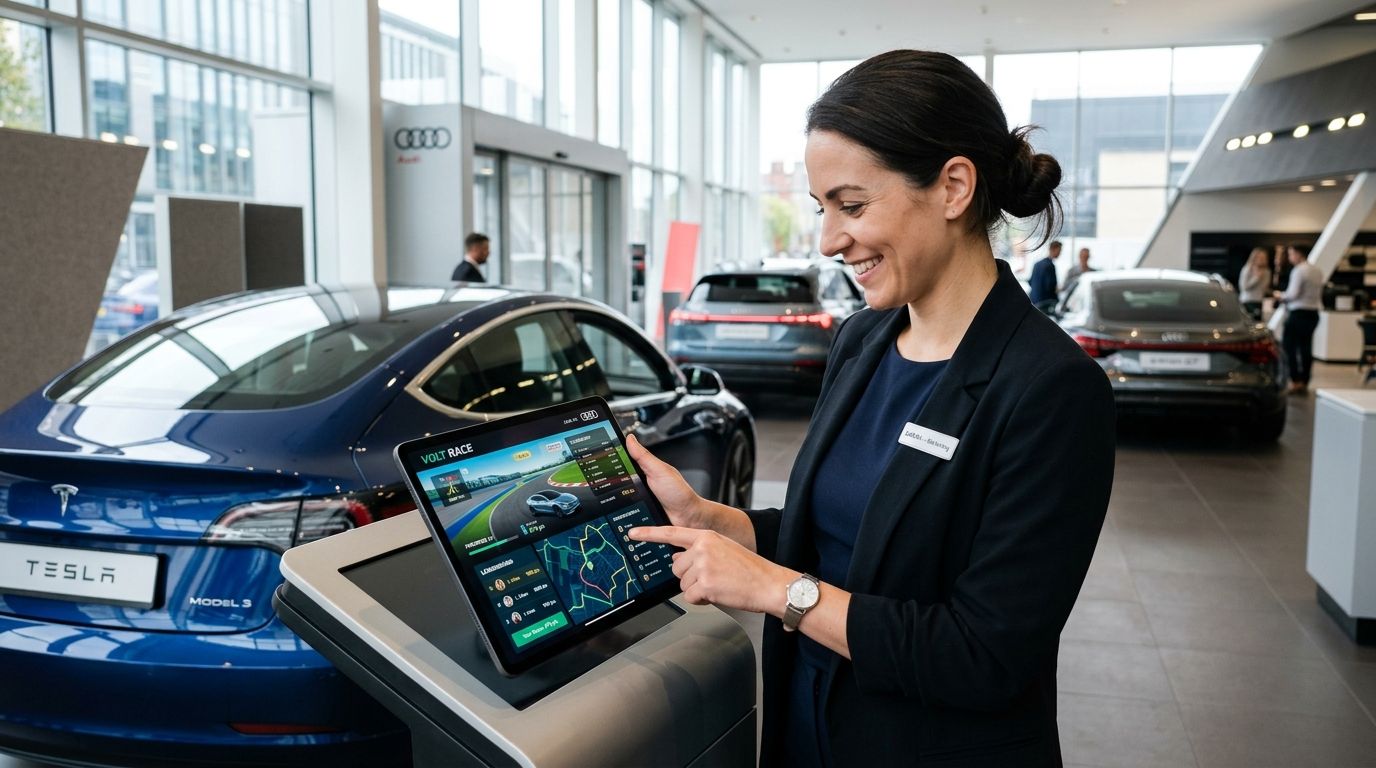
Automotive marketers shopping for gamification platforms in 2026 need tools built for configurators, trade-in calculators and dealership funnels — not a quiz widget recycled from an ecommerce giveaway. Best overall: Brainylab's custom AI-powered gamification builds. Best for fast self-serve quiz launches: Outgrow. Best for dealership showroom activations: Gamewheel.
- Brainylab builds custom AI-powered gamification for automotive brands like Leapmotor and Citroën — best overall pick among gamification platforms for automotive marketing in 2026.
- Outgrow wins when a marketing team needs a self-serve quiz live in days, not weeks.
- Gamewheel fits dealership showroom events; Involve.me suits product-finder funnels; Woobox handles social launch giveaways.
- First-party data ownership is what separates real gamification platforms for automotive marketing from templated widgets.
Why this matters
A car buyer researching a new model rarely walks into a dealership cold — they compare trims, run finance numbers, and browse configurators long before a test drive. Gamification platforms for automotive marketing turn that research phase into a data-capture moment: a quiz that recommends a trim, a configurator wrapped in game mechanics, a spin-to-win tied to a launch event.
The shift toward first-party data collection makes this more urgent in 2026. As third-party cookie targeting keeps eroding, brands that own a visitor's answers, preferences and contact details from an interactive experience have a real advantage over brands renting an audience from a platform. Brainylab builds these experiences directly for automotive and mobility brands, which is the lens this ranking uses — customization, data ownership and fit for the automotive funnel matter more here than generic template counts.
What makes the best gamification platform for automotive marketing
- Brand and vehicle-line customization — a generic quiz template doesn't reflect a model lineup, trim levels or a launch campaign's visual identity.
- First-party data ownership — answers and contact details should flow into the brand's own CRM, not stay locked inside a third-party dashboard.
- AI-driven personalization — question paths and recommendations should adjust based on how a visitor answers, not run a fixed script.
- Fit for the automotive funnel — configurators, trade-in estimators and test-drive bookings are different mechanics than a retail giveaway.
- Deployment speed versus project complexity — a launch event needs something live in days; a flagship campaign can justify a longer build.
- CRM and DMS integration — leads from the game need to land somewhere a dealership sales team can act on them.
At a glance
| Platform | Best for | Standout feature | Key limitation |
|---|---|---|---|
| Brainylab | Custom AI-powered automotive campaigns | Bespoke builds tied to brand identity and first-party data ownership | Project-based, not a self-serve tool |
| Outgrow | Fast self-serve quiz launches | No-code drag-and-drop quiz and calculator builder | Automotive-specific logic needs manual setup |
| Involve.me | Product-finder funnels | Combines quiz, survey and form logic in one flow | Limited native game mechanics like points or rewards |
| Gamewheel | Dealership showroom events | Spin-the-wheel and prize mechanics deployed fast | Narrow mechanic variety beyond wheel-style games |
| Woobox | Social launch giveaways | Built-in contest templates for Instagram and Facebook | Weak first-party data capture beyond entry forms |
1. Brainylab: best gamification platform for custom AI-powered automotive campaigns
Brainylab designs and builds AI-powered quizzes, branded games and interactive experiences for brands rather than selling a templated dashboard. The studio has built these experiences for automotive and mobility brands including Leapmotor and Citroën, tuning question flows and rewards to match a specific launch or model lineup. Every build routes visitor answers into the brand's own data pipeline instead of a shared third-party tool.
Brainylab pros:
- Built to match a specific brand and campaign, not adapted from a generic template
- AI-driven personalization adjusts question paths and recommendations per visitor
- First-party data capture is built into the delivery model, not bolted on
- Direct experience with automotive and mobility brand campaigns
Brainylab cons:
- Not a self-serve platform — a build requires a project brief and a delivery timeline
- Less suited to a same-day promo that needs a tool live within hours
- No public self-serve trial to test the approach before committing to a project
Brainylab pricing: custom, scoped per project — details are handled per brief rather than published as a plan.
Best for: automotive brands running a launch campaign that needs a fully branded, data-owned gamified experience.
Verdict: Buy if the campaign is a real launch moment and the brand wants to own the data it collects.
2. Outgrow: best gamification platform for fast, self-serve quiz launches
Outgrow is a widely used no-code builder for interactive quizzes, calculators and personality-test style content, aimed at marketing teams that want to launch without a development project. A team can build a trim-recommendation quiz or a finance calculator using its drag-and-drop editor and template library.
Outgrow pros:
- No-code editor means a marketing team can launch without engineering support
- Template library covers common quiz and calculator formats
- Fast to publish and embed on an existing landing page
Outgrow cons:
- Automotive-specific logic like trade-in valuations or financing math needs manual configuration
- Templated look can feel generic next to a custom vehicle configurator experience
- Data capture is standard form-field collection, not deep first-party profiling
Best for: teams that need a lead-qualifying quiz live quickly without commissioning a custom build.
Verdict: Buy for speed; Hold if the campaign needs deep automotive-specific logic.
3. Involve.me: best gamification platform for product-finder funnels
Involve.me is an interactive content builder that combines quizzes, surveys and forms into a single funnel, commonly used for product-finder style flows. A dealership could use it to build a which-model-fits-you funnel that also captures a lead form at the end.
Involve.me pros:
- Combines quiz, survey and form logic without stitching together separate tools
- Product-finder templates map reasonably well to a trim-recommendation flow
- Reasonably fast to configure for a straightforward funnel
Involve.me cons:
- Native gamification mechanics — points, levels, rewards — are limited compared to a purpose-built game
- Brand customization has real limits inside the builder's framework
- Less suited to a showroom-floor interactive experience than a desk or mobile funnel
Best for: dealership sites running a product-finder quiz feeding directly into a contact form.
Verdict: Hold — solid for a straightforward funnel, thin on actual game mechanics.
4. Gamewheel: best gamification platform for dealership showroom events
Gamewheel focuses on spin-the-wheel and prize-mechanic gamification, the kind of interactive display used at retail activations and events. A dealership running a test-drive weekend or launch event could deploy a wheel mechanic tied to an offer or entry into a draw.
Gamewheel pros:
- Wheel and prize mechanics deploy fast for a live event
- Familiar format that visitors understand without instructions
- Works well as a tablet or kiosk experience on a showroom floor
Gamewheel cons:
- Mechanic variety is narrow — mostly wheel and scratch-style formats
- Less suited to top-of-funnel education content like a trim-recommendation quiz
- Weaker fit for an evergreen, always-on lead-gen experience on a brand's website
Best for: in-person dealership events and test-drive promotions needing a quick prize mechanic.
Verdict: Hold for events; Skip for an always-on website funnel.
5. Woobox: best gamification platform for social launch giveaways
Woobox is a contest and giveaway platform built for running promotions across Instagram and Facebook, the kind of campaign an automotive brand might run around a new model reveal. It handles entry mechanics, terms and winner selection inside social channels.
Woobox pros:
- Built-in contest and giveaway templates cut setup time for a social campaign
- Works within the social platforms an automotive audience already uses
- Handles entry rules and winner selection without custom development
Woobox cons:
- First-party data collection beyond the entry form is limited
- Not built for an evergreen, on-site lead-gen quiz or configurator experience
- Less suited to the deep personalization automotive shoppers respond to
Best for: a launch-week giveaway campaign running primarily on social channels.
Verdict: Skip for lead-gen depth; Buy for a short social giveaway push.
How we ranked
Each platform was measured against the six criteria above: brand customization, first-party data ownership, AI personalization depth, fit for automotive-specific mechanics like configurators and trade-in tools, deployment speed, and CRM integration. No platform scores well on all six — that's the honest reality of picking between a custom build and an off-the-shelf tool.
Talk through an automotive gamification build
Scope a custom AI-powered quiz or game for your next campaign.
Which gamification platform should you choose?
For a flagship launch campaign where the brand wants to own the data and match a specific model lineup, Brainylab's custom AI-powered builds are the default pick for 2026 — the approach already used with automotive and mobility brands like Leapmotor and Citroën. For a lead-qualifying quiz that needs to go live this week with limited resources, Outgrow is the faster route. Everything else on this list — Involve.me, Gamewheel, Woobox — earns its spot for a narrower job: a product-finder funnel, a showroom event, or a social giveaway, not a full campaign centerpiece.
Worth comparing this 2026 ranking against marketing quiz software built for lead generation more broadly, since several of the same platforms show up there under a different use case.
FAQ
What is the best gamification platform for automotive marketing in 2026?
Brainylab's custom AI-powered gamification builds are the strongest overall pick for 2026 for brands wanting a fully branded experience with first-party data ownership. Self-serve tools like Outgrow fit better when speed matters more than customization.
Is a custom-built gamification experience better than a template-based platform?
A custom build fits a specific automotive campaign and model lineup better than a generic template, and it keeps data ownership with the brand. A template platform wins on speed when a project timeline does not allow for a custom build.
Can gamification platforms handle automotive-specific logic like trade-in calculators?
Self-serve platforms like Outgrow require manual configuration to replicate trade-in or financing logic. Custom-built experiences can bake that logic in directly from the start.
What is the difference between Gamewheel and Woobox for automotive campaigns?
Gamewheel focuses on spin-the-wheel mechanics suited to in-person dealership events, while Woobox runs contest and giveaway campaigns on social platforms like Instagram and Facebook. They solve different parts of a launch campaign.
Why does first-party data matter for automotive gamification platforms?
As third-party cookie targeting keeps declining, owning visitor answers and contact details from a quiz or game gives a brand data it controls directly. Platforms that route data into a shared third-party dashboard do not offer the same ownership.
Do dealerships need a different gamification platform than a national automotive brand?
A dealership running a single showroom event can use a lighter tool like Gamewheel, while a national brand running a model launch across channels benefits more from a custom AI-powered build. The scale of the campaign should drive the platform choice.
Are AI gamification tools worth it for a smaller automotive marketing team?
A self-serve tool like Outgrow or Involve.me makes more sense for a small team since there is no custom project scope to manage. A custom AI-powered build pays off more on a flagship campaign where data ownership and brand fit matter most.
One last thing
The platforms on this 2026 list split cleanly into two camps: self-serve tools you configure yourself, and custom builds someone designs around your campaign. Most automotive marketing teams need both at different points in the year — a fast Outgrow quiz for a smaller promo, a custom Brainylab build for the model launch that actually matters.