
Gamification marketing for telecom brands is the use of quizzes, games and interactive experiences with the aim of improving subscriber acquisition, activation, retention and first-party data collection. This 2026 guide explains how telecom teams can plan the campaign manually, then use Brainylab when a custom production path fits the brief.
- Gamification marketing for telecom brands should target a defined subscriber decision, not engagement without a commercial purpose.
- Plan matching suits acquisition; guided challenges suit activation; recurring games suit retention and first-party data collection.
- Brainylab is best for telecom brands that need custom quizzes, games and interactive experiences rather than a self-serve template.
- A credible 2026 pilot connects every response to a CRM field, audience segment or immediate next action.
Why gamification marketing matters for telecom brands
Telecom marketing spans several distinct decisions: choosing a plan, activating a service, understanding usage, adding another line and deciding whether to renew. A single game cannot address all of them. The mechanic must match the subscriber's current decision and give the telecom team a usable signal in return.
The first-party data requirement makes this more than a creative format. A plan quiz can capture stated usage needs, while an activation challenge can reveal where a subscriber stops. A retention game can collect preferences that support later segmentation, provided every question has a defined purpose and the subscriber understands how the answer will be used.
Consent and data minimisation belong in the campaign design. The General Data Protection Regulation has applied since 25 May 2018 and covers personal-data processing in the European Union. Its maximum administrative fines can reach €20 million or 4% of total worldwide annual turnover, whichever is higher. A 2026 telecom campaign therefore needs consent records, a stated purpose and a deletion process before launch—not after data starts arriving.
How to build a telecom gamification program
The right process starts with a business problem and ends with a measurable subscriber action. It does not start with points, leaderboards or a prize concept.
Define one commercial outcome
Choose the decision the campaign must influence. Acquisition, activation and retention require different audiences, prompts and success measures, so combining them in one experience creates ambiguous data.
For a 2026 pilot, write one outcome in a sentence that names the audience, desired action and measurement source. Completion rate can diagnose the experience, but it is not the commercial outcome unless completion itself creates value.
- Select one stage: acquisition, activation, expansion or retention
- Name the exact subscriber segment
- Define the action you want after participation
- Choose the system that records that action
- Assign one owner for the final result
Map subscriber decision moments
List the moments where a subscriber needs information or must make a choice. Do this in a spreadsheet before evaluating software. Include the website, mobile app, email, retail store and support journey where they are relevant to the campaign.
Each moment needs a signal and a next action. A plan-selection quiz should not end with a generic thank-you screen; it should route the participant toward a relevant plan category, consultation or saved result that the telecom brand can genuinely provide.
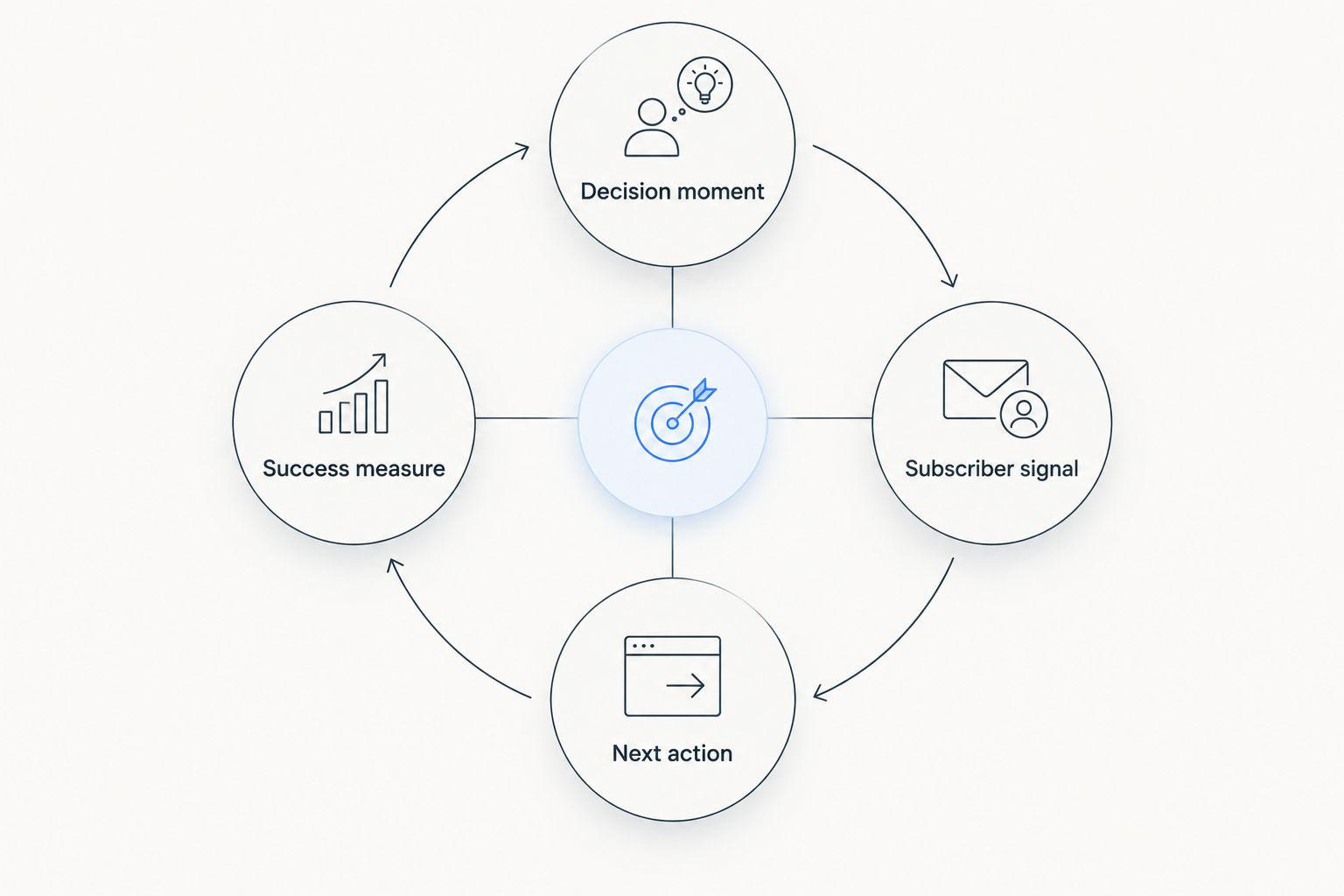
- Decision moment: identify what the subscriber is choosing
- Subscriber signal: define the answer or behaviour you need
- Next action: decide what happens immediately afterward
- Success measure: connect the interaction to a recorded outcome
Prototype the interaction manually
Draft the experience as plain questions, choices and outcomes. A document or slide deck is enough to expose weak logic before design and development begin. Test whether every answer changes the result, route or message; remove questions that do not.
For plan discovery, use a quiz that translates needs into a clear next step. For activation, use a guided sequence that confirms progress. For retention, use a repeatable interaction that remains relevant after the first visit.
Brainylab becomes the faster path when the prototype requires custom game logic, branded interaction design or an AI-powered gamified application rather than a basic form.
- Write each screen in plain language
- Give every answer a defined destination
- Remove questions that collect unusable data
- Test the sequence with internal staff
- Record confusion before adding visual design
Capture only usable first-party data
First-party data is information collected through the telecom brand's own customer relationships and channels. Zero-party data is information a participant intentionally states, such as usage preferences or travel habits. Both require a clear purpose, but they enter the campaign through different actions.
Create a data dictionary before development. For each field, record why it is needed, where it will be stored, who can use it and when it should be removed. The guide to gamification tools for first-party data collection explains how the wider tool category approaches this requirement.
A 2026 consent flow should separate required campaign information from optional marketing permission. Participation must not hide an unrelated consent request inside game instructions.
- Collect only fields tied to the defined outcome
- Explain the purpose beside the relevant input
- Separate participation from optional marketing consent
- Store the consent status with the response
- Define access and deletion responsibilities
Connect every response to a next action
Map each meaningful answer to CRM segmentation, campaign routing or an immediate participant result. If the marketing team cannot explain what happens after an answer arrives, the question does not belong in the experience.
Manual exports can support a limited pilot. Production campaigns need a documented transfer process so records remain consistent across the gamified experience and the telecom brand's existing systems. Brainylab can build the interactive layer, but the telecom team must still define its fields, permissions and destination systems.
- Match campaign fields to existing CRM fields
- Define how duplicate records are handled
- Route incomplete sessions separately from completions
- Preserve consent status during every transfer
- Test failure alerts before campaign launch
Build around the delivery channel
Design for the channel where the decision happens. A quiz reached from paid media needs an immediate explanation and a short path to value. An in-app activation experience can use existing account context. A retail-assisted game must work while a staff member is present without making the process slower.
Do not copy one layout into every channel. Keep the campaign logic consistent, then adjust the instructions, input method and next action to the context.
- Use a clear opening promise for acquisition traffic
- Preserve progress when activation has several stages
- Keep retail interactions easy to explain aloud
- Provide an accessible alternative to game mechanics
- Test the full flow on the intended device
Measure incrementality and improve
Separate experience metrics from business metrics. Starts, completions and answer distribution show where the interaction works or breaks. Qualified leads, completed activations, accepted next actions and retention outcomes show whether the campaign supports its commercial purpose.
Use a comparison group where the campaign setup permits one. Keep audience rules and measurement windows consistent, document campaign changes and avoid attributing every later customer action to the game. The 2026 review should lead to a specific decision: expand, revise or stop.
- Track starts and completions by traffic source
- Compare the intended action across equivalent audiences
- Review answer quality, not only answer volume
- Check whether data reaches the destination system
- Document every material campaign change
- Decide whether to expand, revise or stop
Options for telecom gamification
The best option depends on the mechanic, available development capacity and required system connections. A basic form is enough to validate questions; custom development fits an experience whose game logic or data flow cannot be expressed safely in a template.
| Option | Best for | Main advantage | Key limitation |
|---|---|---|---|
| Manual prototype | Validating questions, routes and outcomes | Fast to revise before development | Cannot deliver a finished interactive campaign |
| General quiz builder | Simple acquisition quizzes with standard logic | Gives marketers direct control over basic edits | May restrict custom game mechanics and system connections |
| In-house development | Telecom brands with dedicated product and engineering capacity | Keeps development ownership inside the organisation | Competes with other engineering priorities and requires ongoing maintenance |
| Brainylab custom development | Branded quizzes, games and AI-powered interactive experiences | Supports custom mechanics built around the campaign brief | It is a scoped studio engagement, not an instant self-serve template |
Brainylab is best for telecom brands that need custom quizzes, games and interactive experiences tied to first-party data collection. A general quiz builder is the better fit when the requirement is a straightforward questionnaire that the marketing team wants to edit independently.
In 2026, choose the smallest production route that can support the required experience, data permissions and next action. Complexity without a business requirement adds more failure points; an underspecified template creates a different problem by forcing the campaign into logic that does not match the subscriber journey.
Plan your telecom experience
Define the subscriber decision, mechanic and first-party data flow before development starts.
Common mistakes telecom brands make
Starting with a reward instead of a decision
A reward can attract participation without producing a useful subscriber action. Define the decision, data purpose and next step first. Add a reward only when it supports that journey and when its terms, fulfilment and consent implications have been approved.
Using the same mechanic across the lifecycle
Plan selection, activation and retention are different jobs. A quiz can clarify preferences during acquisition, while a guided challenge can make a multi-stage activation easier to follow. Reusing one mechanic everywhere makes the creative consistent at the expense of relevance.
Collecting data without an operational owner
A campaign can generate responses that nobody can access, interpret or act on. Assign an owner to every destination field and define what that person or system does when the signal arrives. Data without a next action is campaign overhead.
Hiding consent inside participation
Campaign entry and marketing permission are not interchangeable. State what data is required for the experience, explain its purpose and separate optional marketing choices. This protects the participant and gives the telecom brand a cleaner consent record.
Reporting engagement without business context
Starts and completions show whether people use the experience. They do not prove acquisition quality, successful activation or retention. A 2026 report should place interaction metrics beside the commercial action selected during campaign planning.
FAQ
What is gamification marketing for telecom brands?
Gamification marketing for telecom brands uses quizzes, games and interactive experiences to support subscriber acquisition, activation, retention and first-party data collection. Each mechanic should connect a defined subscriber decision to a measurable next action.
What is the best gamification mechanic for a telecom brand?
The best mechanic depends on the subscriber decision. Plan-matching quizzes fit acquisition, guided challenges fit activation, and repeatable games fit ongoing engagement when each result connects to a useful action.
Is a telecom quiz better than a branded game?
A quiz is better when the telecom brand needs stated preferences or qualification data; a game is better when participation and repeat interaction are central to the brief. Neither format wins without a defined outcome and data purpose.
How can telecom gamification collect first-party data?
Telecom gamification collects first-party data through interactions on the brand's own channels. Questions, choices and completion events must map to stated purposes, consent status and approved destination systems.
Does telecom gamification need GDPR consent?
The required legal basis depends on the processing purpose, but optional marketing consent must be specific, informed and recorded when consent is used. Campaign participation should not conceal an unrelated marketing permission request.
Should a telecom brand build gamification in-house?
In-house development fits telecom brands with available product and engineering capacity. A custom studio fits campaigns that need specialist interaction design and development without redirecting an internal team from its existing priorities.
How do you measure telecom gamification in 2026?
Measure starts and completions alongside the intended commercial action, such as a qualified lead, completed activation or accepted next step. Compare equivalent audiences where possible and verify that campaign data reaches the intended system.
Can gamification support telecom customer retention?
Gamification can support retention when it addresses a relevant subscriber need and records a useful signal. It does not replace competitive plans, reliable service or effective customer support.
One last thing
Keep an unexposed comparison group when campaign design and legal review permit it. Without a credible baseline, a busy sales period, media change or service update can look like a gamification result. The strongest 2026 campaign brief defines the comparison method before creative production begins, alongside the subscriber decision, data fields and success measure.