
Best overall AI quiz tool for market research in 2026: Brainylab, for custom-built gamified quizzes that turn campaign engagement into first-party data. Best for a fast self-serve launch: Typeform. Best budget option: Riddle.
- Brainylab wins for AI quiz tools for market research built around a specific brand and campaign, not a generic template.
- Typeform is the fastest self-serve pick when a market research quiz needs to go live today.
- Outgrow generates AI-written quiz questions and scoring logic for teams running interactive content at scale.
- Riddle is the budget pick for lightweight polls and personality quizzes without heavy AI features.
- Six AI quiz tools for market research are ranked here by data capture depth, not just design polish.
Why this matters
Cookie-based tracking keeps shrinking every year, and 2026 is no exception — brands still need to know who their audience is, what they want, and how to reach them again without third-party lists. A quiz is one of the few formats a person finishes voluntarily. A survey link gets ignored; a gamified quiz with a personalized result at the end gets shared.
AI now handles the part that used to eat a research team's week: drafting branching questions, scoring answers, and segmenting respondents as the data comes in instead of after a manual export to a spreadsheet. That's the exact gap Brainylab has filled for brands like Argeta, Sava Insurance, Lidl, Leapmotor and Citroën — five recognizable names built on interactive quizzes and games instead of static forms.
The tools below aren't interchangeable. A five-person startup testing a landing page headline needs something different than an enterprise CPG team running a multi-market product launch. This guide ranks six AI quiz tools for market research in 2026 by what each one is actually built to do, not by which one has the flashiest homepage.
What makes the best AI quiz tool for market research
Before trusting a ranking, check it against the criteria that actually decide whether a quiz produces usable research data or just page views:
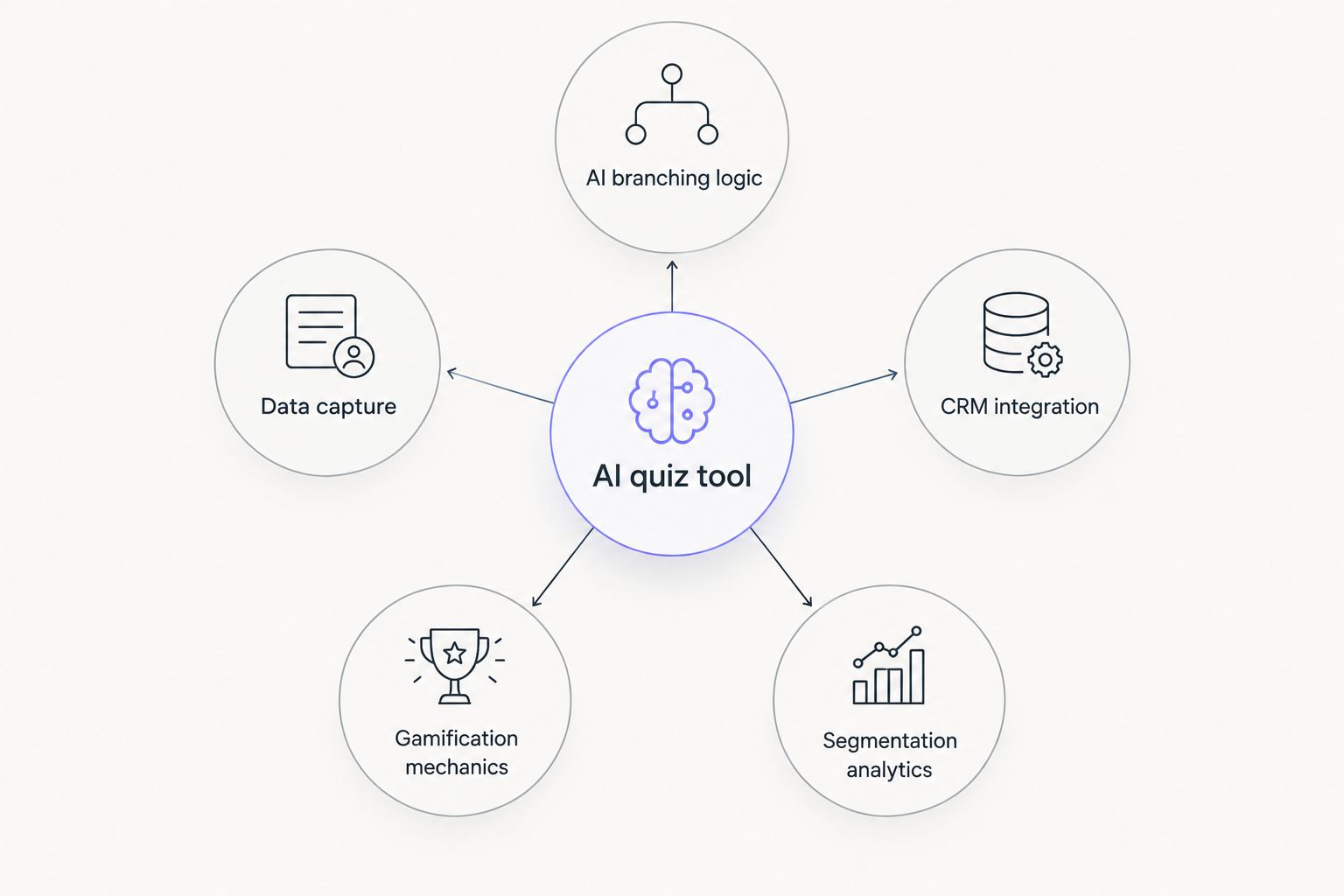
- AI-assisted question and branching logic — the tool drafts and adapts question paths so respondents never answer something irrelevant to them.
- First-party and zero-party data capture with consent built in — not an email field bolted onto a generic form. Compare options for first-party data collection.
- CRM and marketing platform integrations — responses need to land somewhere a research team can query without a manual export.
- Gamification mechanics that raise completion — progress bars, personalized results, points or badges that give the respondent a reason to finish.
- Segmentation and analytics dashboards — answers get sliced by demographic or psychographic profile inside the platform, not in a separate spreadsheet.
- Multi-language and multi-market support — necessary for any campaign running across more than one country.
Pick the tool that scores well on the criteria your research question actually needs. A quick brand-preference poll doesn't need enterprise CRM integration, and a multi-market product launch shouldn't run on a template built for a single coach's email list.
Build a custom research quiz
Get a gamified quiz designed around your actual campaign and audience.
AI quiz tools for market research at a glance
| Tool | Best for | Standout feature | Key limitation |
|---|---|---|---|
| Brainylab | Custom-built market research campaigns | Bespoke AI-driven quiz design tied to the campaign brief | Project-based, not a self-serve subscription |
| Typeform | Fast, self-serve market research quizzes | One-question-per-screen conversational format | Limited native gamification |
| Outgrow | AI-generated interactive content at scale | AI content generator for quizzes and calculators | Learning curve for complex branching |
| Interact | Small business audience testing | Pre-built templates by niche | Limited customization for research-grade logic |
| Jebbit | Enterprise zero-party data capture | Deep CRM and MarTech integrations | Setup complexity favors large teams |
| Riddle | Budget-conscious polls and quizzes | Simple builder for quizzes, polls, personality tests | Fewer AI features than newer entrants |
1. Brainylab: best AI quiz tool for custom market research campaigns
Brainylab builds AI-powered quizzes, games and interactive experiences shaped around a specific research brief rather than a drag-and-drop template. The studio designs the branching logic, the scoring, and the result screens around what a brand actually needs to learn about its audience. It has delivered gamified campaigns for brands including Argeta, Sava Insurance, Lidl, Leapmotor and Citroën, where the quiz doubles as both an engagement tool and a first-party data source tied to a bigger campaign.
Brainylab pros:
- Built around the actual research question, not a stock template
- Data output is designed for post-campaign segmentation, not just email capture
- Delivered for brands across retail, insurance, automotive and FMCG
- Multi-language builds for campaigns running across more than one market
Brainylab cons:
- Not a self-serve tool — quizzes are scoped as a project, so there's a lead time before launch
- No published pricing tier, so budget approval starts with a conversation
Best for: brands and agencies running a market research campaign that needs a custom-branded interactive experience. Verdict: Buy — for teams that want a quiz built around their actual research question instead of a generic template.
2. Typeform: best AI quiz tool for a fast self-serve launch
Typeform presents one question per screen in a conversational format that's been standard for online forms and surveys for years. Marketing teams use it in 2026 when a market research quiz needs to go live the same day, without waiting on a design or development cycle. It handles basic branching and works fine as a starting point before a team decides it needs deeper segmentation.
Typeform pros:
- Fast to set up and publish
- One-question-per-screen format that keeps completion moving
- Broad integration library with common marketing tools
Typeform cons:
- Native gamification — points, badges, personalized results — is limited next to dedicated quiz builders
- Deep segmentation usually means exporting responses elsewhere
Best for: teams that need a market research quiz live today without custom design work. Verdict: Buy — for speed over depth.
3. Outgrow: best AI quiz tool for interactive content at scale
Outgrow builds interactive content — quizzes, calculators, assessments — with AI tools that help draft questions and scoring logic. It's aimed at marketing teams running a high volume of interactive campaigns rather than a single one-off quiz, which shows in how much configuration the platform exposes.
Outgrow pros:
- AI content generation cuts time spent writing quiz copy from scratch
- Handles more complex scoring logic than basic quiz tools
- Covers calculators and assessments alongside quizzes
Outgrow cons:
- Setting up multi-branch logic has a learning curve the first time
- Matching brand identity closely takes more manual design work
Best for: marketing teams generating a high volume of interactive content, not just a single campaign quiz. Verdict: Hold — strong for scale, more than a single campaign usually needs.
4. Interact: best AI quiz tool for small business audience testing
Interact provides pre-built quiz templates organized by niche, aimed at small businesses and coaches who want a quiz funnel live without hiring a developer. The templates cover common use cases out of the box, which trades flexibility for speed.
Interact pros:
- Templates get a basic quiz live within a day
- Built-in email capture and result pages
- Lower learning curve than enterprise-grade tools
Interact cons:
- Limited customization for research-specific branching logic
- Segmentation depth is thinner than tools built for dedicated research teams
Best for: a small business testing simple audience preferences without hiring a developer. Verdict: Buy — for informal research on a smaller list.
5. Jebbit: best AI quiz tool for enterprise zero-party data capture
Jebbit is built for zero-party data capture at enterprise scale, with integrations into large CRM and MarTech stacks. It shows up most often with retail and CPG teams running interactive experiences across several markets at once, where the data needs to flow directly into an existing customer record.
Jebbit pros:
- Deep CRM and MarTech integrations
- Built specifically for zero-party data collection, not adapted from a survey tool
- Scales across large, multi-market campaigns
Jebbit cons:
- Setup complexity favors teams with dedicated MarTech resources
- More than a single small campaign typically needs
Best for: enterprise teams with an existing MarTech stack that needs a zero-party data source plugged in. Verdict: Hold — for teams with the technical resources to use it fully.
6. Riddle: best budget AI quiz tool for lightweight polls and quizzes
Riddle is a straightforward builder for quizzes, polls and personality tests, positioned as the lighter, lower-cost option on this list. It skips most of the AI-generation layer that newer tools lean on and focuses on getting a simple format published fast.
Riddle pros:
- Simple interface, fast to learn
- Covers polls and personality tests alongside quizzes
- Good fit for lightweight audience engagement, not just formal research
Riddle cons:
- Fewer AI-assisted features than newer entrants
- Segmentation and CRM integration options are more limited
Best for: teams that want lightweight polls and quizzes without paying for advanced AI features. Verdict: Buy — for the budget-conscious pick.
How we ranked these AI quiz tools for market research
Every tool on this list was measured against the same six criteria: AI-assisted branching logic, first-party and zero-party data handling, CRM integration depth, gamification mechanics, segmentation and analytics, and multi-market support. None of the six wins on every criterion — that's the point of a decision tree instead of a single leaderboard. A tool built for campaign engagement scores differently against these same six criteria than one built for formal research.
Which AI quiz tool for market research should you choose?
If the research question is specific to your brand and tied to a bigger campaign, Brainylab is the pick for 2026 — the quiz gets built around what you're actually trying to learn, not squeezed into a template. If it needs to go live this afternoon, Typeform gets there fastest, and cross-tabbing can happen after export. If the budget is tight and the ask is a simple poll or personality quiz, Riddle covers it without extra features that go unused.
“A market research quiz that feels like a game gets finished; one that feels like a form gets abandoned.”
For the undecided reader: start with what happens to the data after the quiz closes. If nobody on the team can explain how responses get segmented and reused, the tool is wrong regardless of how it looks.
FAQ
What's the best AI quiz tool for market research in 2026?
Brainylab is the strongest choice for custom-built market research quizzes tied to a specific brand and campaign in 2026. Typeform and Riddle fit better when a quiz needs to launch fast without a custom build.
Is Typeform good for market research?
Typeform works well for fast market research quizzes thanks to its one-question-per-screen format, but its native gamification and segmentation are limited, so responses often need exporting for deeper analysis.
What is zero-party data and why does it matter for quizzes?
Zero-party data is information a respondent shares directly and knowingly, like quiz answers, rather than data collected by tracking behavior. Quizzes work because people willingly finish them in exchange for a personalized result.
Are AI quiz tools better than traditional surveys for market research?
AI quiz tools tend to see higher completion because branching logic keeps questions relevant, while long static surveys lose respondents partway through. The tradeoff is more upfront design work than a plain form.
How much does an AI quiz tool for market research cost?
Pricing varies by vendor and by whether the build is custom or a self-serve subscription. Check current pricing directly with each provider before comparing options.
Can small businesses use AI quiz tools for market research?
Yes. Tools like Interact and Riddle are built for smaller teams that want a quiz live without hiring a developer, though they offer less segmentation depth than enterprise platforms like Jebbit.
Which AI quiz tool integrates best with a CRM?
Jebbit is built around CRM and MarTech stack integrations for enterprise teams. Outgrow and Typeform cover more common marketing tool integrations for mid-sized campaigns.
Do gamified quizzes actually improve market research response rates?
Gamification elements like progress bars, personalized results and points are used specifically because they raise completion versus static surveys, though the effect depends on how well the quiz matches audience intent.
One last thing
Most teams pick the cheapest self-serve tool first and only discover the segmentation gap after the campaign ends — the answers sit in a spreadsheet instead of a dashboard that can slice them by profile. Check how a tool handles data after the quiz closes before comparing templates or design options; that's the feature that decides whether the quiz was market research or just engagement theater in 2026.